Dlite Blocks

can AAC blocks be load-bearing

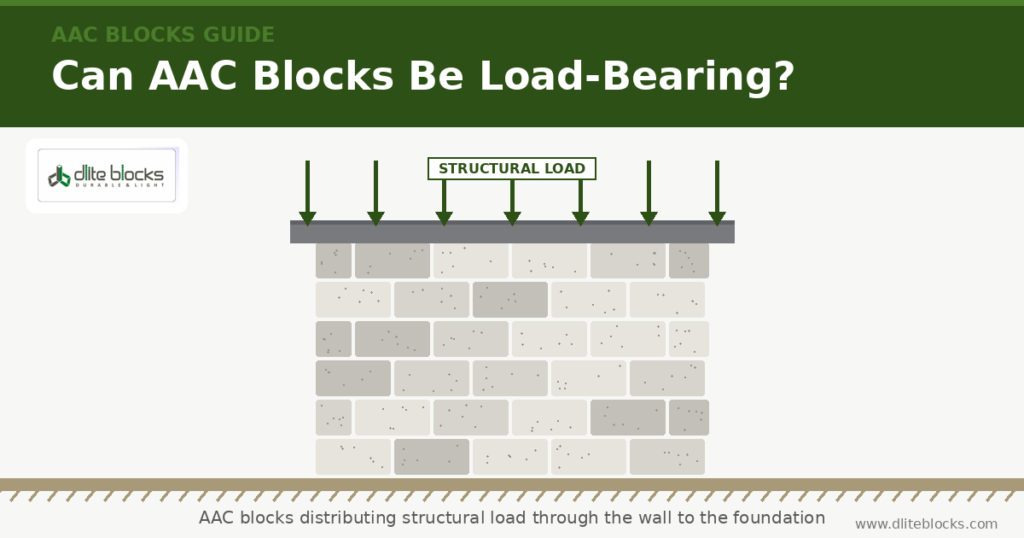
Can AAC Blocks Be Load-Bearing? A Complete Guide for Builders and Homeowners

If you’re planning a residential or commercial project in India, you’ve likely come across AAC blocks as a modern alternative to red clay bricks. But one question keeps coming up among engineers, contractors, and homeowners alike: can AAC blocks be load-bearing? The short answer is yes – AAC blocks can absolutely be used as load-bearing material, but with important conditions around block density, wall height, and structural design. Autoclaved Aerated Concrete, commonly known as autoclaved aerated concrete blocks or by the popular brand name siporex blocks, has been used in load-bearing construction across Europe for over 90 years, and Indian builders are now adopting the same principles for low-rise and mid-rise structures. In this guide, we’ll break down exactly when an AAC block can carry structural load, what IS code guidelines say, how load-bearing AAC differs from standard infill-wall usage, and what to look for when choosing an AAC block supplier in India. Understanding Load-Bearing vs. Non-Load-Bearing Use Every AAC block manufactured under IS 2185 Part 3 has a rated compressive strength, typically ranging from 3 N/mm² to 5 N/mm² depending on the density grade. This strength determines whether the block is suitable only for partition walls (non-load-bearing) or whether it can support the weight of slabs and upper floors (load-bearing). For load-bearing applications, structural engineers generally recommend: This is different from how most urban high-rises use AAC blocks – as infill walls within an RCC frame structure, where the blocks themselves don’t bear structural load but still contribute significantly to thermal insulation, fire resistance, and speed of construction. Market Analysis: Why Load-Bearing AAC Is Gaining Ground in India Demand for autoclaved aerated concrete blocks in India has grown steadily as builders look for faster, lighter, and more sustainable alternatives to conventional brick masonry. A few market trends are worth noting: This shift means that when evaluating an AAC block manufacturing company, buyers today are not just comparing price per block – they’re evaluating structural suitability, density consistency, and technical support for load-bearing designs. What to Check Before Using AAC Blocks for Load-Bearing Walls Before finalizing a project with load-bearing AAC masonry, verify the following with your chosen AAC block factory or supplier: Working with an experienced AAC blocks company that understands both manufacturing and site-application requirements makes a significant difference in project outcomes, especially for first-time load-bearing AAC projects. Conclusion AAC blocks are structurally capable of load-bearing applications, particularly for low-rise residential and commercial buildings up to G+2 or G+3, provided the correct density grade, reinforcement, and jointing practices are followed. As one of the established AAC block manufacturers, Dlite Blocks produces IS 2185 Part 3 compliant AAC blocks suited for both load-bearing and infill wall applications across Maharashtra and pan-India markets. Frequently Asked Questions

Can AAC Blocks Be Load-Bearing? A Complete Guide for Builders and Homeowners Read More »
myths about AAC blocks

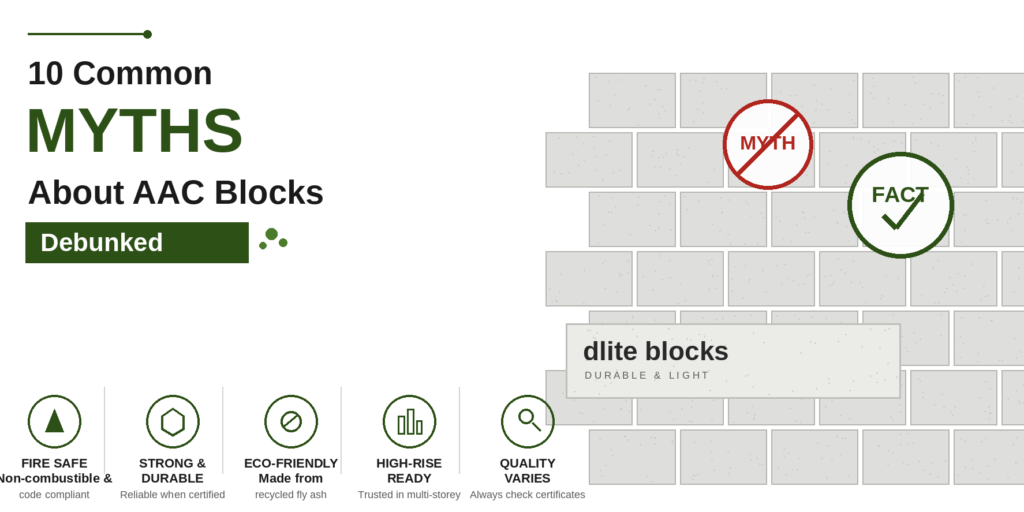
10 Common Myths About AAC Blocks Debunked

Despite growing adoption across India, myths about AAC blocks still persist, often based on outdated assumptions from early, poorly-made batches or simple word-of-mouth confusion with other materials. If you’re a builder, contractor, architect, or homeowner comparing AAC blocks against fly ash bricks or red bricks, it’s worth separating these myths from what the material actually does. Here are the 10 most common myths about AAC blocks, debunked with facts. Myth 1: AAC Blocks Are Too Fragile for Real Construction Fact: This myth usually comes from handling low-quality, improperly autoclaved blocks. Blocks manufactured to IS 2185 Part 3 standards by a reputable AAC block manufacturing company go through precise autoclaving that gives them stable compressive strength suitable for both load-bearing and partition walls. The fragility perception fades quickly once builders switch to a properly certified AAC block supplier. Myth 2: AAC Blocks and Siporex Blocks Are Different Materials Fact: They’re not. Siporex blocks are simply a branded name for AAC (Autoclaved Aerated Concrete) blocks, made from the same core mix of fly ash, cement, lime, gypsum, and an aeration agent. Buyers sometimes assume Siporex is a premium alternative to AAC blocks, but it’s the same category of product — the differentiator is always the quality of the specific AAC block factory producing it, not the name on the packaging. Myth 3: AAC Blocks Absorb Too Much Water Fact: AAC blocks do have higher initial water absorption than dense red bricks because of their cellular structure — but this is exactly why proper plastering and correctly applied AAC block jointing mortar matter. Once finished correctly, AAC block walls perform reliably even through Maharashtra’s monsoon season. The issue isn’t the material; it’s skipping the recommended finishing steps. Myth 4: AAC Blocks Are Always More Expensive Than Fly Ash Bricks Fact: Comparing AAC blocks price to fly ash brick price per piece is misleading, since one AAC block typically replaces several standard bricks. Once mortar consumption, plaster thickness, and labour time are factored in, AAC blocks often work out more cost-effective per square foot of finished wall — a comparison worth asking any AAC block supplier to walk you through. Myth 5: AAC Blocks Aren’t Fire Safe Fact: The opposite is true. AAC blocks are non-combustible and offer strong fire resistance because of their inorganic composition and cellular air-pocket structure, which slows heat transfer. This is one of the reasons AAC blocks are increasingly specified for schools, hospitals, and commercial buildings where fire safety codes are strict. Myth 6: All AAC Block Manufacturers Produce the Same Quality Fact: Manufacturing quality varies significantly between AAC block manufacturers in India. Autoclaving time, pressure, raw material ratios, and quality testing procedures all differ by plant. Buyers comparing AAC block manufacturers in Maharashtra should ask for density, compressive strength, and thermal conductivity test data rather than assuming all AAC block manufacturers meet the same standard. Myth 7: Any Cement Mortar Works Fine With AAC Blocks Fact: Ordinary cement-sand mortar creates thick joints (12-15mm) that increase thermal bridging and material use. A dedicated AAC block jointing mortar is formulated for the dense, smooth surface of autoclaved blocks, allowing thin 2-3mm joints that preserve the wall’s insulation performance and reduce cracking. Sourcing jointing mortar from unrelated jointing mortar suppliers instead of a matched product is a common cause of on-site issues. Myth 8: AAC Blocks Are Only Suitable for Low-Rise Buildings Fact: AAC blocks are used globally in mid-rise and high-rise projects as infill and partition walls, valued precisely because their light weight reduces the structural load on the building frame compared to red brick or dense concrete block. Leading AAC block manufacturers in India regularly supply high-rise residential and commercial projects. Myth 9: AAC Blocks Aren’t Eco-Friendly Because They Use Cement Fact: AAC blocks use fly ash — an industrial byproduct that would otherwise go to landfill — as their primary raw material, reducing both waste and the need for clay excavation required by red bricks. While cement is part of the mix, the overall environmental footprint of AAC blocks is considerably lower than traditional fired-clay bricks. Myth 10: Any Supplier With a Low Quote Is a Good Deal Fact: Price alone doesn’t indicate quality. A low quote from an unverified AAC block supplier can mean under-cured blocks, inconsistent dimensions, or inflated transport costs hidden elsewhere. It’s worth evaluating AAC blocks manufacturers on test certification, factory transparency, and whether they also supply a matched AAC block jointing mortar — not on price alone. What This Means for Your Next Project Most myths about AAC blocks trace back to either outdated information or experience with a poor-quality AAC block supplier — not a flaw in the material itself. When sourced from a certified AAC block manufacturing company and paired with the right jointing mortar, AAC blocks consistently outperform traditional alternatives on speed, insulation, and durability. Dlite Blocks, based in Akola, Maharashtra, manufactures AAC blocks and matched jointing mortar to IS 2185 Part 3 standards, supplying builders, architects, and homeowners across Maharashtra and pan-India. Explore specifications on the AAC blocks and jointing mortar product pages or get in touch with questions before your next project. For more buying guides and construction insights, visit the Dlite Blocks blog. FAQ

10 Common Myths About AAC Blocks Debunked Read More »

how AAC fly ash blocks are manufactured

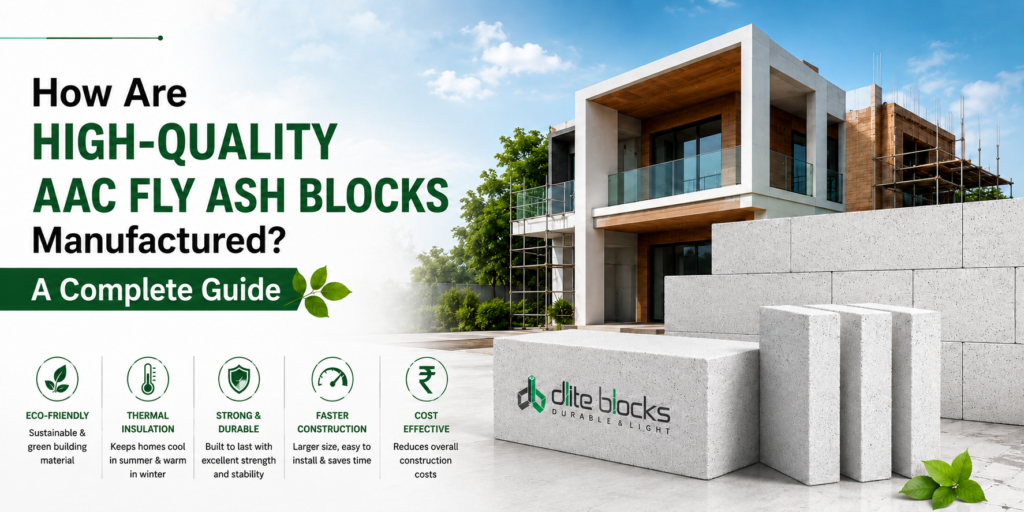
How Are High-Quality AAC Fly Ash Blocks Manufactured?

If you have seen a modern building going up recently, you have probably noticed large, lightweight, light-grey blocks being used instead of traditional red clay bricks. These are autoclaved aerated concrete blocks (AAC blocks). They are eco-friendly, highly durable, and excellent at keeping buildings cool. But have you ever wondered how AAC fly ash blocks are manufactured? Let’s break down the complete process that turns simple raw materials into these high-tech building blocks into simple, easy-to-understand steps. What Goes Into the Mix? (Raw Materials) Before the magic happens inside the factory, the right ingredients must be gathered. High-quality manufacturers, like the top-tier AAC block manufacturing company brands, use precise recipes. The main ingredients include: The Step-by-Step Manufacturing Process A premier AAC block factory follows a highly automated, scientific process to ensure every block comes out perfect. 1. Raw Material Preparation & Slurry Making First, the fly ash is mixed with water in a massive container to create a thick mixture called slurry. This slurry is then pumped into a dosing system where cement, lime, and gypsum are accurately weighed and mixed in. 2. Aeration and Curing (The “Rising” Stage) Once the main mixture is ready, a tiny amount of aluminium powder is added. The mixture is quickly poured into large iron moulds. Inside the mould, a chemical reaction takes place between the aluminium, lime, and water. This reaction releases hydrogen gas, which creates millions of microscopic air pockets inside the mix. The mixture expands to twice its original volume – just like bread dough rising in an oven! Within a few hours, the mix solidifies into a soft, cake-like texture. 3. Precision Cutting Once the green cake (soft block mixture) is stiff enough to hold its shape, it is removed from the mould. It is then moved to a high-precision cutting machine. Using thin, strong steel wires, the giant cake is sliced vertically and horizontally into exact block sizes. Brands like Dlite use advanced cutting lines to ensure that every single block has razor-sharp, uniform edges, which helps builders save on mortar during construction. 4. Autoclaving (Steam Curing) This is the most crucial step in AAC block manufacturing. The cut blocks are loaded into a massive, tube-like pressure vessel called an autoclave. Inside the autoclave, the blocks are baked under high-pressure steam at temperatures reaching around 180°C to 190°C for 10 to 12 hours. This intensive steam-curing process triggers a chemical reaction that gives the autoclaved aerated concrete blocks their ultimate strength, structural stability, and lightweight properties. 5. Sorting and Packaging After cooling down, the blocks are pulled out of the autoclave. Quality inspectors check them for cracks, weight, and strength. The approved blocks are then carefully stacked on wooden pallets, wrapped in protective plastic, and prepared for dispatch. Why Choose High-Quality Blocks Like Dlite? Not all blocks are created equal. Understanding how AAC fly ash blocks are manufactured helps you appreciate why choosing premium AAC block manufacturers like Dlite ensures consistent quality. Dlite blocks offer: Conclusion The journey from industrial fly ash to a high-performing building material is a fascinating blend of chemistry and engineering. Understanding how AAC fly ash blocks are manufactured reveals the power of advanced automated technology in a modern AAC block factory, which transforms simple raw materials into strong, sustainable, and lightweight building solutions. Sourcing your materials from reliable AAC block manufacturers like Dlite ensures your structure is energy-efficient, safe, and cost-effective. Investing in premium autoclaved aerated concrete blocks is the smartest way to build a strong foundation for future generations. FAQ

How Are High-Quality AAC Fly Ash Blocks Manufactured? Read More »

AAC blocks construction time

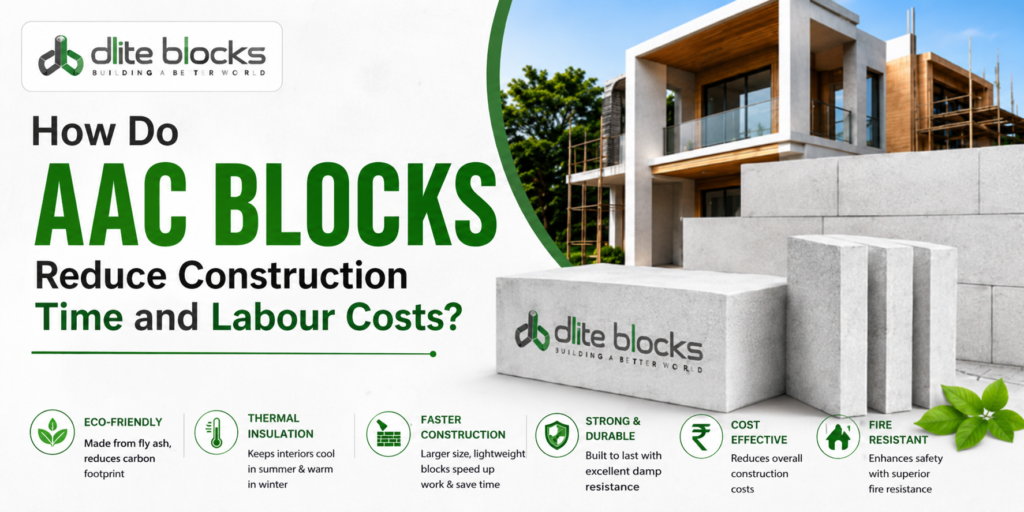
How Do AAC Blocks Reduce Construction Time and Labour Costs?

AAC blocks construction time is significantly reduced — they cut construction time by roughly 25–30% and reduce walling labour costs by lowering the number of units laid, the volume of mortar mixed, the plaster applied, and the dead load the foundation must carry. A 600×200×200 mm AAC block replaces about nine standard red bricks, so a mason lays fewer units, uses thin-bed jointing mortar instead of thick site-mixed mortar, and finishes the wall with a skim coat instead of 12–15 mm of plaster. Labour is now the fastest-rising line item on most Indian sites. Material prices get scrutinised; idle man-days do not. Below is where AAC blocks actually claw that time back — and where they do not. How much lighter are AAC blocks than red bricks? AAC blocks have a dry density of 550–650 kg/m³, against 1,600–1,920 kg/m³ for red clay bricks. In practice a completed AAC wall weighs roughly one-third of an equivalent brick wall. That weight difference shows up as labour savings in two places: Why does block size speed up wall construction? A standard brick is 225×100×75 mm. A standard AAC block is up to 600×200×200 mm — around nine bricks’ worth of wall in a single lift. Fewer units means fewer laying actions, fewer joints, and fewer alignment corrections. The same daily wall area is achieved with a smaller crew, which shrinks the daily wage bill directly rather than theoretically. How does thin-bed jointing mortar reduce labour cost? Conventional brickwork needs 10–12 mm of site-mixed mortar, which needs a skilled mason to keep the course level. AAC blocks are cut to tight dimensional tolerance, so they take a 2–3 mm thin-bed jointing mortar instead. The consequences: Jointing mortar is not optional. AAC laid in ordinary cement mortar loses most of its speed advantage and gains joint-line cracking. Match the block to a purpose-made adhesive such as Dlite AAC Block Jointing Mortar. Do AAC block walls need less plaster? Yes. Because the blocks are dimensionally accurate, the wall face comes out true. Where a rough brick wall needs a thick levelling coat, an AAC wall typically needs only a thin plaster or skim coat. That removes days from the finishing programme, reduces cement and sand consumption, and frees a plastering crew earlier for the next block of work. How does lower dead load save foundation labour? Lighter walls mean a lighter building. A lighter building means: On a multi-storey RCC frame, the dead-load reduction from AAC infill walls is one of the few walling decisions that shows up in the structural drawings, not just the finishing bill. Where AAC Blocks Construction Time Savings Do Not Apply While AAC blocks construction time is generally reduced, certain site conditions and construction practices can limit or offset these expected time savings. Two honest caveats, because sites find them out anyway: The bottom line Every hour saved on site is margin retained. AAC blocks compress the walling programme at five separate points — handling, laying, jointing, plastering, and foundation work — which is why the time saving compounds instead of showing up as a single line item. Planning a project? Talk to the Dlite Blocks team about the right block grade and jointing mortar for your build. FAQ

How Do AAC Blocks Reduce Construction Time and Labour Costs? Read More »

AAC blocks: the future of construction

Why Are AAC Blocks the Future of Construction in India?

AAC blocks are becoming the default walling material for modern construction in India because they are up to 50–70% lighter than red clay bricks, insulate far better against heat, absorb less water, and build roughly 30% faster. For most residential, commercial, and institutional projects in 2026, they cut both build time and lifetime running costs — which is why builders across the country are switching away from traditional bricks. Here is a clear, data-backed look at what AAC blocks are, how they compare to red bricks, where the India market is heading, and where a manufacturer like Dlite Blocks fits in. What Are AAC Blocks, and How Are They Made? AAC stands for Autoclaved Aerated Concrete. AAC blocks are precast, lightweight blocks made from fly ash, cement, lime, gypsum, and water, mixed with a small amount of aluminium as an aeration agent, then steam-cured under pressure inside an autoclave. During curing, the mix expands and traps millions of tiny air pockets — and those pockets give the finished block its low weight and strong thermal performance. Because the main raw material is fly ash — an industrial waste product from thermal power plants — AAC blocks reuse waste instead of stripping fertile topsoil the way clay-brick kilns do. Indian brick-making is estimated to consume the top 300 mm of fertile agricultural soil in affected areas over decades, an environmental cost documented by researchers at the MIT Energy Initiative. That single fact is a big reason government and green-building bodies now favour fly-ash-based blocks. Key technical specifications of AAC blocks: These specifications follow the Indian standards published by the Bureau of Indian Standards (BIS). AAC Blocks vs Red Bricks: The Core Differences A single AAC block can replace several red bricks. That one fact drives most of the advantages — fewer joints, less mortar, lower dead load on the structure, and lighter foundations. Parameter Red Clay Bricks AAC Blocks Standard size ~225 × 100 × 75 mm Up to 600 × 200 × 200 mm Dry density 1,600–1,920 kg/m³ 550–650 kg/m³ Thermal conductivity 0.6–1.0 W/mK 0.16–0.42 W/mK Water absorption 15–20% ≤ 10% Construction speed Slower (small units) ~30% faster Raw material Clay + high kiln energy Fly ash, lower energy Where AAC clearly leads is thermal insulation and water resistance. Lower thermal conductivity means interiors stay cooler through the Indian summer, directly cutting air-conditioning load. For raw strength, good-quality units of both materials are adequate for most residential walls — in multi-storey buildings, AAC is typically used as non-load-bearing infill inside an RCC frame. The full engineering trade-offs are documented by references like The Constructor. The India Market in 2026: Why the Shift Is Accelerating The numbers explain the switch. India’s AAC blocks market reached USD 4.0 billion in 2025 and is projected to hit USD 9.1 billion by 2034, growing at a 9.5% CAGR, according to the IMARC Group. Meanwhile, India still produces roughly 250 billion red clay bricks every year — one of the largest such industries in the world — which shows just how much of the market is still open to conversion. Three forces are driving the change: government housing schemes like the Pradhan Mantri Awas Yojana (PMAY), which lists AAC blocks among preferred fast-build materials; rising demand for green building certifications from the Indian Green Building Council; and a GST rate of just 5% on AAC blocks. Add climbing labour and energy costs, and clay-brick economics keep weakening while AAC’s faster builds and lower running costs look stronger every year. Saving Time and Money on Site Cost is where AAC blocks win over the life of a build, not just at the checkout. Because the blocks are much larger than red bricks, masons lay walls faster. You need less cement mortar to join them, and their smooth, dimensionally accurate faces need very little plaster. The bigger saving is structural. Lighter walls mean lower dead load, which can reduce the steel and concrete needed in foundations and columns. And because of their insulation, AAC walls cut the electricity spent on cooling for the entire life of the building. The right comparison is the total cost of ownership — fewer units, less mortar and plaster, lighter foundations, and years of lower power bills — not the price of a single block. Where Dlite Blocks Fits In Dlite Blocks is an AAC fly-ash block manufacturer based in Akola, Maharashtra, supplying dealers and builders across Maharashtra and Madhya Pradesh, with a presence in Indore. Its leadership team brings nearly five decades of combined experience in the AAC industry. At its AAC block factory in Akola, Dlite produces precision-cut AAC fly ash blocks alongside its own AAC block jointing mortar — a thin-bed adhesive that speeds up masonry and improves wall integrity. Its blocks have been used across residential, commercial, healthcare, and institutional projects. For any builder weighing AAC blocks vs red bricks, sourcing from a quality-controlled AAC blocks company is what turns AAC’s theoretical advantages into real on-site performance, because density consistency and dimensional accuracy matter as much as the material itself. Conclusion: Build Smarter For most new construction in India in 2026 — apartments, offices, hospitals, schools, and modern homes — AAC blocks are the smarter choice. They cut structural weight, lower cooling and heating bills through superior insulation, resist fire and moisture better, and build faster. Red bricks still suit tight-budget, small-scale, load-bearing work where upfront cost is the only priority. But as energy costs rise and green-building norms tighten, the long-term case keeps tilting toward AAC. Planning your next project? Talk to the Dlite Blocks team about the right AAC block grade and jointing mortar for your build. Frequently Asked Questions (FAQ)

Why Are AAC Blocks the Future of Construction in India? Read More »

AAC Blocks vs Red Bricks

AAC Blocks vs Red Bricks: Which Is Better for Construction in India?

AAC blocks are better than red bricks for most modern construction in India because they are lighter, offer far superior thermal insulation, absorb less water, and build faster — while red clay bricks remain a low-cost, proven option for small load-bearing structures. The right choice depends on your project type, budget, and how much you value long-term energy savings.If you are choosing a walling material in 2026, this is the single biggest cost-and-comfort decision you will make. Below is a clear, data-backed comparison of AAC blocks vs red bricks, the latest India market picture, and where a manufacturer like Dlite Blocks fits in. What Are AAC Blocks and Red Bricks? Red clay bricks are the traditional walling unit — clay is moulded and fired in kilns at high temperature. They have been used for centuries and are valued for proven strength and low upfront cost.AAC (Autoclaved Aerated Concrete) blocks are precast, lightweight blocks made from fly ash, cement, lime, gypsum, and water, then steam-cured under pressure in an autoclave. Tiny air pockets formed during curing make them strong yet up to 50–70% lighter than bricks. Because they reuseindustrial fly ash, they are also a greener choice. AAC Blocks vs Red Bricks: Full Comparison Table Parameter Red Clay Bricks AAC Blocks Standard size 9″ × 4″ × 3″ (≈ 225×100×75mm) Up to 24″ × 8″ × 8″ (≈600×200×200 mm) Dry density 1,600–1,920 kg/m³ 550–650 kg/m³ Weight Heavier (more units per wall) 50–70% lighter Compressive strength 2.5–3.5 N/mm² 3–4.5 N/mm² Thermal conductivity 0.6–1.0 W/mK (poor insulation) 0.16–0.42 W/mK (excellentinsulation) Water absorption 15–20% ≤ 10% Fire resistance (100 mm wall) Up to 2 hours Up to 4 hours Construction speed Slower (small units, moremortar) ~30% faster (large units, thinbed mortar) Eco-friendliness Clay + high kiln energy Fly-ash based, lower energy A single AAC block replaces several bricks, which means fewer joints, less mortar, lower dead load on the structure, and lighter foundations. For thermal performance and water resistance, AAC clearly leads. For raw compressive strength in good-quality units, both perform well enough for most residential walls — typically AAC is used as non-load-bearing infill in RCC-framed buildings. Specifications follow Indian standards published by the Bureau of Indian Standards, and the engineering trade-offs are documented in detail by references like The Constructor. The India Market in 2026: Why the Shift Is Accelerating The numbers explain why builders are switching. India’s AAC blocks market reached USD 4.0 billion in 2025 and is projected to hit USD 9.1 billion by 2034, growing at a 9.5% CAGR (IMARC Group). Yet AAC still accounts for only about 16–18% of total construction in India —meaning the runway is enormous as the market moves away from clay bricks.Three forces are driving this: government housing schemes like Pradhan Mantri Awas Yojana (PMAY), rising demand for green building certifications, and a GST rate of just 5% on AAC blocks. Add rising labour and energy costs, and clay-brick economics keep weakening while AAC’s faster builds and lower running costs look stronger every year. Where Dlite Blocks Fits In Dlite Blocks is a leading AAC fly-ash block manufacturer in India, operating out of Akola, Maharashtra, with a presence in Indore. The company is led by a leadership team with nearly five decades of combined experience in the AAC industry, including senior production roles at established pioneers of AAC fly-ash blocks in India.Dlite produces precision-cut AAC fly-ash blocks alongside its own AAC block jointing mortar, a thin-bed adhesive that speeds masonry work and improves wall integrity. Its blocks have been used across residential, commercial, healthcare, and institutional projects, including Arwade Infra in Indore and Ganesh Hospital in Amalner. For builders weighing AAC blocks vs red bricks, sourcing from a quality-controlled manufacturer is what turns AAC’s theoretical advantages into real on-site performance. Conclusion: Which Should You Choose? When comparing AAC blocks vs red bricks, for most new construction in India in 2026 — apartments, offices, hospitals, schools, hotels, and modern homes — AAC blocks are the smarter choice. They cut structural weight, lower cooling and heating bills through superior insulation, resist fire and moisture better, and build faster, reducing labour costs and project timelines. Over a building’s life, these savings typically outweigh the slightly higher cost per block compared to bricks. Red bricks still suit tight-budget, small-scale, or load-bearing work where upfront cost is the only priority. But as energy costs rise and green-building norms tighten, the long-term case keeps tilting toward AAC. FAQ

AAC Blocks vs Red Bricks: Which Is Better for Construction in India? Read More »

AAC blocks for residential or commercial construction

Are AAC Blocks Better for Residential or Commercial Construction?

AAC blocks for residential or commercial construction work well in both cases, but the right choice depends on load requirements, budget, and build speed. For homes, AAC blocks offer lightweight construction and better thermal insulation; for commercial buildings, they speed up construction and reduce structural load on high-rise frames. More builders are now switching from traditional red bricks to AAC blocks for exactly these reasons. Below, we compare AAC blocks for residential vs. commercial projects – and show how a leading brand like BuildSmart fits each use case. What are AAC Blocks? AAC stands for Autoclaved Aerated Concrete. These lightweight blocks are made by mixing sand, lime, cement, and a rising agent that creates millions of tiny air pockets inside. Because they are cured under high pressure in a specialised AAC block factory, they become incredibly strong while remaining lightweight. Residential Projects: Comfort and Savings When building a home, your main priorities are comfort, safety, and monthly savings. Here is how AAC blocks deliver on those promises: 1. Superior Thermal Insulation Homes built with these blocks stay cooler in the summer and warmer in the winter. The air pockets inside the blocks act as a natural barrier against heat. This means your air conditioner won’t have to work as hard, leading to much lower electricity bills. 2. Peace and Quiet (Soundproofing) Nobody wants to hear traffic noise or the neighbours’ loud TV while trying to relax. AAC blocks have excellent sound reduction qualities, giving your family the privacy and quiet environment they deserve. 3. Pest and Fire Resistance Homes made with blocks from top AAC block manufacturers are highly safe. They are 100% inorganic, which means termites, rodents, and pests cannot damage them. Plus, they offer amazing fire resistance, keeping your loved ones safe. For residential projects, BuildSmart provides the perfect balance of comfort and long-term durability. Commercial Projects: Speed and Scale Commercial projects—like office towers, hotels, and schools—have different needs. They focus heavily on speed, budget, and structural efficiency. Here is how AAC blocks fit into large-scale builds: 1. Faster Construction Speed Time is money in commercial real estate. AAC blocks are much larger than traditional red bricks. Because they cover more area per block and are easy to cut, workers can build walls up to three times faster. 2. Significant Cost Reductions Since these blocks are lightweight, they reduce the overall dead weight of the building. This means engineers can design a lighter structural frame, saving massive amounts of money on steel and cement. 3. Eco-Friendly and Green Certified Many commercial projects today need to meet strict green building standards. Because an AAC block factory uses non-toxic materials and recycled fly ash, using these blocks helps projects earn valuable green certifications easily. For large-scale commercial developments, partnering with trusted AAC block manufacturers like BuildSmart ensures a steady supply of high-quality materials to keep the project on schedule. Side-by-Side Comparison Feature Residential Projects Commercial Projects Primary Benefit High comfort, lower energy bills, and noise reduction. Faster construction, lower structural weight, and cost savings. Size Preference Standard sizes for easy handling in tight residential spaces. Larger custom blocks to speed up massive wall constructions. Wall Thickness Thicker outer walls for maximum insulation and privacy. Optimised thickness to maximise usable carpet area inside offices. The Verdict: Which is Better? The truth is, AAC blocks are a winning choice for both types of construction, but for different reasons. Homeowners love them for the cosy, quiet, and energy-efficient lifestyle they provide. Commercial builders love them because they speed up project timelines and slash structural costs. When planning your next build, make sure to source your materials from reliable AAC block manufacturers. Choosing a premium brand ensures that your autoclaved aerated concrete blocks meet the highest standards of strength and safety. Whether you are building a cosy villa or a 20-storey office plaza, making the smart switch will secure your building’s future for decades to come. FAQ

Are AAC Blocks Better for Residential or Commercial Construction? Read More »

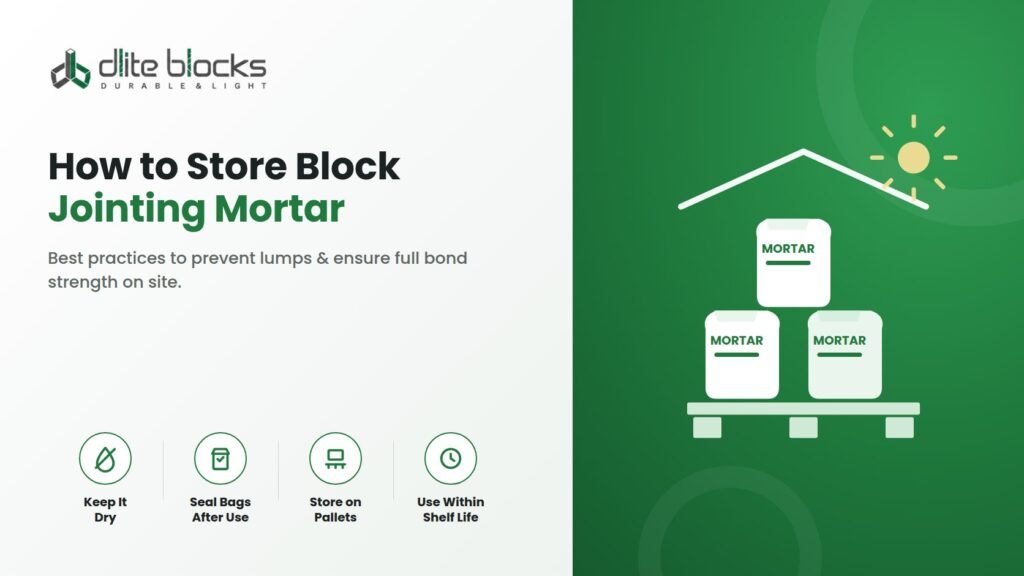
How to store block jointing mortar — keep it dry, seal bags after use, store on pallets, and use within shelf life — Dlite Blocks

How to Store Block Jointing Mortar: Best Practices to Prevent Lumps & Ensure Bond Strength

When building a house or a commercial property, using high-quality AAC blocks is only half the battle. The real strength of your walls lies in the glue that holds them together: the AAC block jointing mortar. If you choose a premium product like Dlite block jointing mortar, you are already on the right track. However, even the best materials can lose their strength if they are not stored correctly. Poor storage leads to moisture absorption, which creates hard lumps and ruins the bond strength. To help you get the most out of your construction materials, we have put together the ultimate guide on how to store your mortar properly. Why Proper Storage Matters Before jumping into the tips, let’s understand the enemy: moisture. AAC block jointing mortar contains cement and special polymers. The moment moisture or humidity touches the powder, a chemical reaction starts. This results in hard lumps. If you try to break these lumps and use the mortar anyway, it will not stick properly, leading to weak joints and cracks in your walls. By following the right storage rules, you protect your investment and ensure your walls stay rock-solid. Best Practices for Storing Block Jointing Mortar 1. Keep It Off the Ground (Use Wooden Pallets) Never stack your mortar bags directly on a concrete or dirt floor. Floors absorb moisture from the ground, which easily transfers to the bags. The Fix: Always stack your Dlite mortar bags on raised wooden pallets or planks. Keep them at least 6 to 8 inches off the ground to allow air to circulate underneath. 2. Stay Away from the Walls Just like floors, external walls can sweat and trap moisture, especially during the rainy season. 3. Use the “First In, First Out” (FIFO) Rule Mortar has a shelf life, usually around 6 to 12 months from the manufacturing date. Older bags should always be used first. When buying from trusted block jointing mortar manufacturers, check the packaging dates and arrange your stock so that the oldest bags are right at the front. 4. Stack Bags in a Criss-Cross Pattern Do not just pile bags on top of each other in a single straight tower. High stacks can easily topple over, tearing the bags open. 5. Protect the Site from Weather If you are storing materials directly on the construction site, weather protection is non-negotiable. What to Do If You Spot Lumps? Before mixing your next batch, do a quick quality check. Roll the bag gently on the floor before opening it. When you open a bag of Dlite mortar, the powder should feel completely dry and free-flowing. If you find small lumps that easily turn to powder when you squeeze them with your fingers, the mortar is still safe to use. However, if the lumps are hard like stones, the material has already set. Throw those lumps away—they will reduce the bond strength of your wall. Conclusion Perfect storage is the secret to a successful, crack-free wall. By keeping your bags dry, elevated, and well-ventilated, you ensure that the mortar retains its maximum stickiness and strength. Always source your materials from reliable AAC block jointing mortar manufacturers to ensure you get fresh, high-grade products from day one. Buying from leading AAC block jointing mortar brands guarantees peace of mind, but storing it right guarantees a structure that lasts a lifetime. Keep these simple tips in mind for your next project! FAQ

How to Store Block Jointing Mortar: Best Practices to Prevent Lumps & Ensure Bond Strength Read More »

AAC Blocks

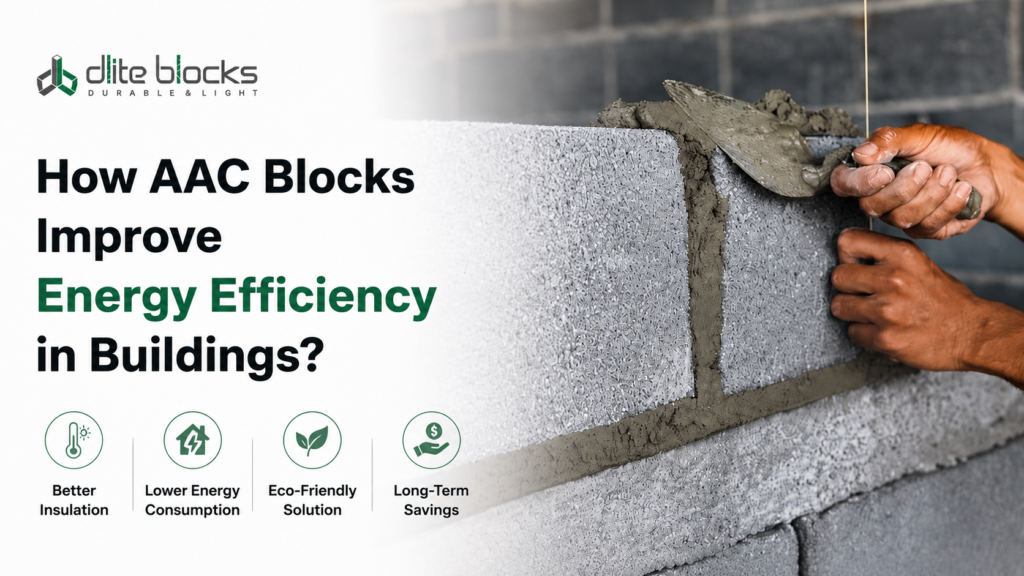
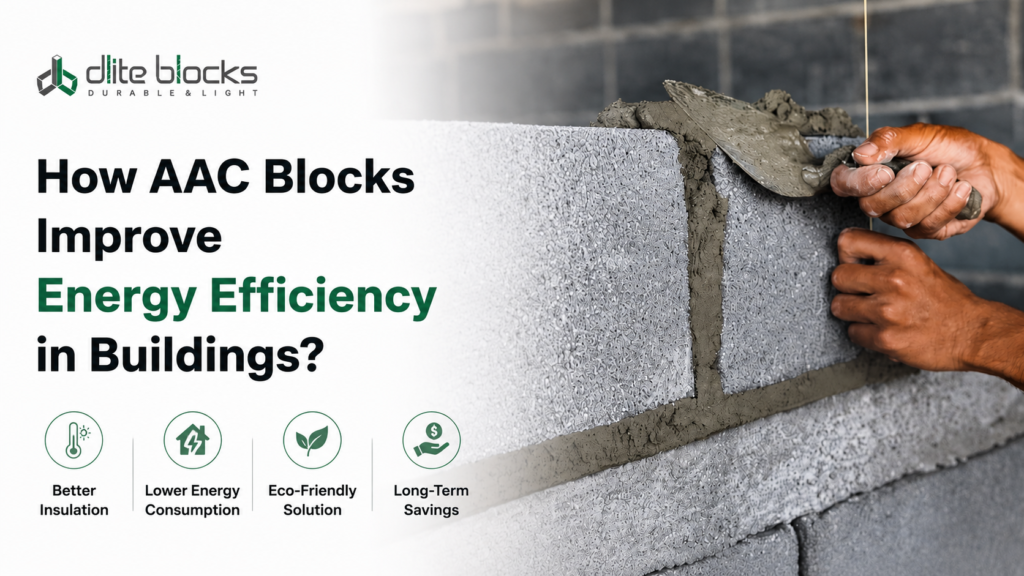
How AAC Blocks Improve Energy Efficiency in Buildings?

When building a dream home or a modern commercial space, we all want two things: durability and comfort. But with rising temperatures and skyrocketing electricity bills, AAC Blocks Energy Efficiency has become a top priority. Every builder and homeowner is looking for materials that keep interiors cool in summer and warm in winter without forcing the air conditioner to run 24/7. This is exactly where modern technology steps in to replace traditional red bricks. If you want a smart, eco-friendly, and cost-effective solution, it is time to look at AAC blocks. Autoclaved Aerated Concrete (AAC) is a lightweight, precast building material that is rapidly transforming the construction industry. Let’s dive into how these innovative blocks make your buildings incredibly energy efficient and why choosing a top-tier AAC blocks company can change the way you live. AAC Blocks Energy Efficiency: What Makes Them Thermally Efficient? The secret behind the energy-saving power of AAC lies in its unique structure. Unlike dense traditional clay bricks, these blocks are manufactured with millions of tiny, microscopic air pockets inside them. Air is a terrible conductor of heat, which, in this case, is a massive advantage! These tiny air pockets act as a natural barrier, drastically slowing down the transfer of heat from the outside to the inside of your building. When you use products from leading AAChttps://www.dliteblocks.com/product/aac-fly-ash-blocks/ block manufacturers in india, you are essentially wrapping your building in a protective thermal blanket. During scorching summers, the blazing outdoor heat struggles to penetrate the walls. In winter, the warmth inside the rooms is trapped effectively, reducing the need for heavy indoor heating. Real Savings on Your Electricity Bills Because these blocks maintain a balanced and stable indoor temperature, your air conditioning and heating systems don’t have to work in overdrive. When planning your project, using trusted brands like Dlite ensures that the blocks are manufactured to the highest quality standards, maximizing these thermal benefits for decades to come. Better For Your Pocket, Better For The Planet Energy efficiency isn’t just about saving money; it is also about reducing our carbon footprint. Buildings are responsible for a massive chunk of global energy consumption. By reducing the reliance on artificial heating and cooling, structures built with AAC contribute significantly to lesser energy demand. Furthermore, the manufacturing process of these blocks is highly sustainable. They use non-toxic ingredients and generate virtually zero waste. Choosing a reliable AAC blocks company means you are opting for a green building material certified for sustainable development. Brands like Dlite focus on creating eco-friendly solutions that help builders achieve green building certifications effortlessly. Beyond Energy: The Added Advantages While energy efficiency is a major highlight, AAC blocks offer a complete package of benefits that traditional bricks simply cannot match: Conclusion The future of construction belongs to smart, sustainable, and energy-efficient materials. Passing on traditional clay bricks for your next project is the first step toward building a smarter home. By trusting reliable AAC block manufacturers in India, you ensure your structure stands strong, safe, and heavily insulated against extreme weather. High-quality options from brands like Dlite offer the perfect balance of strength and thermal insulation, ensuring that your investment pays off every single month through reduced power bills. Make the switch today for a cooler tomorrow! FAQ

How AAC Blocks Improve Energy Efficiency in Buildings? Read More »

AAC Blocks in India

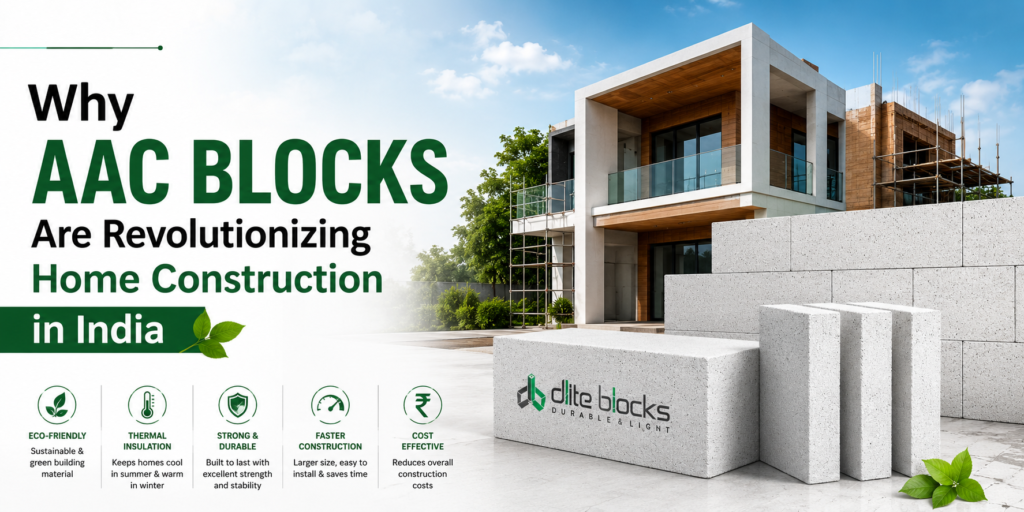
Why AAC Blocks Are Revolutionizing Home Construction in India

Building a home in India is a big dream for many people. Today, new materials like AAC blocks are making this dream easier, faster, and better. Leading brands like Dlite are helping bring this modern solution to homeowners and builders across the country. These blocks are strong, lightweight, and eco-friendly, making them a smart choice. Many builders now prefer them over traditional bricks, and every top AAC blocks company is highlighting their advantages. Let’s understand in simple words why AAC blocks are becoming so popular. What Are AAC Blocks? AAC stands for Autoclaved Aerated Concrete. These are lightweight blocks made using cement, lime, sand, and a small amount of aluminum powder. They have tiny air bubbles inside, which makes them light and easy to handle. A good AAC blocks factory uses advanced technology to make these blocks strong and durable. Brands like Dlite are known for providing high-quality AAC blocks in India. 1. Lightweight and Easy to Use One of the biggest advantages of AAC blocks is that they are very light compared to red bricks. This makes them easy to carry and install.   Workers can build faster  Less load on the building structure  Easier transportation  This helps reduce overall construction time and effort. 2. Faster Construction Time is very important in construction. AAC blocks help complete projects quickly.   Bigger size means fewer blocks needed  Easy cutting and shaping  Less mortar required  A reliable AAC blocks company like Dlite ensures consistent size and quality, which helps builders work without delays. 3. Better Strength and Durability Even though they are lightweight, AAC blocks are strong. They can handle pressure and last for many years.   Crack-resistant  Long-lasting structure  Suitable for all types of buildings  Many builders trust products from a good AAC block factory because of their strength and quality. 4. Energy Efficient Homes AAC blocks help keep homes cool in summer and warm in winter.   Good thermal insulation  Less need for air conditioners  Saves electricity bills  This makes them perfect for Indian weather conditions. Dlite blocks are specially designed to improve energy efficiency in homes. 5. Eco-Friendly Choice Today, people want to build homes that are safe for the environment. AAC blocks are a green building material.   Made with less natural resources  Produces less waste  Reduces pollution  A modern AAC blocks company focuses on sustainable production methods, making AAC blocks a smart choice for eco-conscious buyers. 6. Fire and Sound Resistance Safety is very important in any home. AAC blocks offer great protection.   Fire-resistant material  Helps prevent fire spread  Good sound insulation  Homes built using AAC blocks are quieter and safer compared to traditional brick houses. 7. Cost-Effective in the Long Run AAC blocks may look slightly expensive at first, but they help save money over time.   Less labour cost  Lower cement usage  Reduced maintenance  A trusted AAC block factory ensures quality blocks that reduce repair costs in the future. Brands like Dlite offer value for money with long-lasting performance. 8. Smooth Finish and Less Plaster AAC blocks have a smooth surface, which reduces the need for heavy plastering.   Saves time and materials  Better wall finish  Easy painting  This is another reason why builders prefer AAC blocks for modern homes. Why Choose Dlite? When choosing AAC blocks, quality matters a lot. Dlite is a well-known name that provides strong and reliable blocks.   Made in advanced manufacturing units  Consistent size and quality  Trusted by builders across India  Whether you are building a small home or a big project, Dlite ensures you get the best results. Conclusion AAC blocks are truly changing the way homes are built in India. They are lightweight, strong, eco-friendly, and cost-effective. With the support of a good AAC blocks company and a trusted AAC block factory, you can build a better and smarter home. As more people learn about their benefits, AAC blocks will continue to grow in popularity. Choosing the right brand like Dlite can make your construction journey smooth and stress-free. If you are planning to build your dream home, AAC blocks are definitely worth considering.  

Why AAC Blocks Are Revolutionizing Home Construction in India Read More »

About

Dlite Blocks is a leading manufacturer of high-quality AAC Fly Ash Blocks, redefining construction standards with unwavering commitment to precision and innovation.

Our Certification

Social Links

Copyright © 2026 Dlite Blocks Pvt. Ltd.
Powered By Marketing in Mars
Scroll to Top