
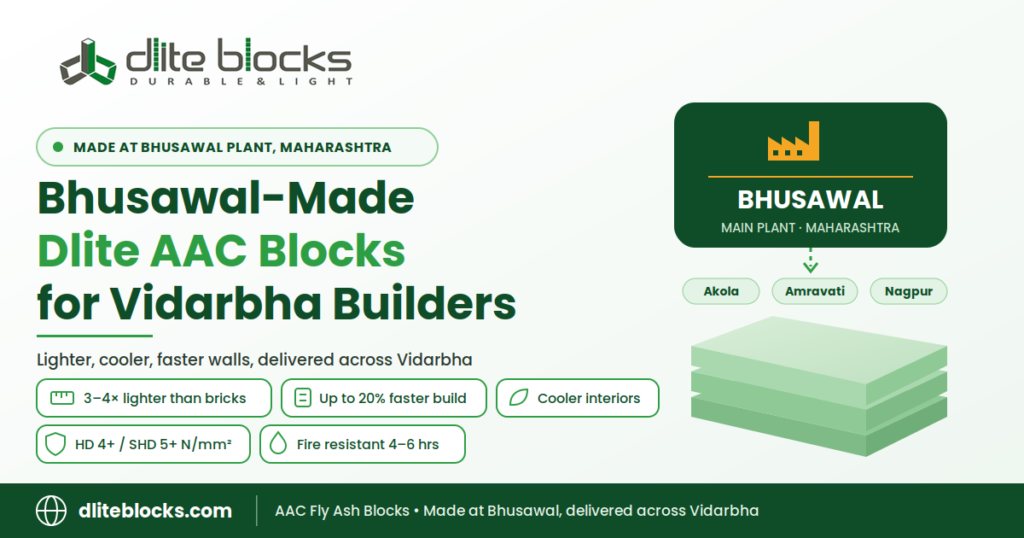
Vidarbha is known for its harsh summers, and builders here need walls that do more than hold up a roof. They need walls that keep homes cooler, speed up construction and last for decades. That is why a growing number of builders in Nagpur, Akola, Amravati and across the region choose Dlite AAC Fly Ash Blocks, manufactured at Dlite’s main plant in Bhusawal, Maharashtra. Dlite AAC blocks Bhusawal are manufactured at Dlite’s main plant in Maharashtra and supplied to builders across Vidarbha who need cooler homes, faster construction and dependable delivery.
This guide explains where the blocks are made, why the Bhusawal plant matters to Vidarbha projects, and how Dlite AAC blocks perform on heat, speed, weight, fire safety and sound.
Why do builders in Vidarbha prefer Dlite AAC fly ash blocks?
Vidarbha builders prefer Dlite AAC fly ash blocks for their heat insulation, consistent quality, faster masonry and dependable supply from the Bhusawal manufacturing plant in Maharashtra. Dlite Blocks’ registered office is in Akola.
In short, builders choose Dlite because the blocks:
- Slow heat transfer, keeping interiors cooler in summer
- Are 3–4 times lighter than red bricks
- Speed up construction, with up to 20% shorter build time cited by Dlite
- Offer 4–6 hours of fire resistance, depending on wall thickness
- Are made from fly ash, a by-product of thermal power plants
- Are supplied from a manufacturing plant within Maharashtra
Where are Dlite AAC blocks manufactured?
Dlite AAC fly ash blocks are manufactured at the main plant in Bhusawal, Maharashtra. Bhusawal is in the Jalgaon district of northern Maharashtra, close to the Vidarbha region, and it is a well-connected rail and road town. Having the main plant in the state brings practical benefits to builders:
- Shorter delivery routes: Blocks travel within Maharashtra rather than across state borders, which helps with planning and transport cost.
- Better dispatch planning: Large projects need steady material flow. A dedicated plant makes it easier to schedule deliveries to match construction progress.
- Consistent quality: Manufacturing under one controlled process helps keep block size, density and strength uniform from batch to batch.
- Easier coordination: Builders can discuss quantities, delivery timelines and specifications directly with the Dlite team.
What is an AAC fly ash block?
AAC stands for Autoclaved Aerated Concrete. These blocks are made from fly ash, cement, lime, gypsum and an aeration agent. During manufacturing, millions of tiny air pores form inside the block. The blocks are then cured in an autoclave under steam pressure.
The result is a block that is light, strong enough for walling, and highly insulating. Using fly ash means the blocks make productive use of a by-product of thermal power generation, rather than relying on clay.
Five reasons Vidarbha builders choose Dlite AAC blocks
1. Cooler homes in hot summers
Vidarbha’s summer heat is among the most demanding in India. Dlite AAC blocks have a thermal conductivity below 0.24 W/m·K, thanks to their tiny air pores. Heat moves slowly through the wall, so interiors stay more comfortable for longer. This can help reduce air-conditioning load and electricity costs, which matters for homes, offices and hospitals alike.
2. Faster construction
AAC blocks are larger than red bricks, so fewer blocks and fewer joints are needed per square metre of wall. Dlite cites up to 20% shorter construction time. For developers, faster masonry means earlier handover, lower labour days on site and better schedule control.
3. Lighter structures, lower costs
Dlite AAC blocks are 3–4 times lighter than red bricks. This reduces the dead load on the structure, which can help in the design of beams, columns and foundations. Lighter blocks are also easier to carry, lift and place, and cheaper to transport.
4. Fire safety and durability
AAC blocks are non-combustible. Depending on wall thickness, Dlite blocks provide 4–6 hours of fire resistance. They are also termite-resistant and handle harsh weather well, making them suitable for the heat of Vidarbha summers and the heavy rain of the monsoon season.
5. Quieter interiors
A 200 mm Dlite AAC wall offers a Sound Reduction Index of 45 dB. That helps reduce noise between apartments, classrooms, hospital rooms and offices.
Dlite AAC fly ash block specifications
| Feature | Dlite AAC Fly Ash Blocks |
|---|---|
| Thermal conductivity | Below 0.24 W/m·K |
| Strength grades | HD (4+ N/mm²), SHD (5+ N/mm²) |
| Weight vs. red bricks | 3–4 times lighter |
| Fire resistance | 4–6 hours (depends on wall thickness) |
| Sound Reduction Index | 45 dB (200 mm wall) |
| Construction time | Up to 20% shorter |
| Main manufacturing plant | Bhusawal, Maharashtra |
| Registered office | Damle Chowk, Akola |
AAC blocks vs red bricks: a quick comparison
| Factor | Dlite AAC Blocks | Red Clay Bricks |
|---|---|---|
| Weight | 3–4 times lighter | Heavy |
| Heat insulation | Thermal conductivity below 0.24 W/m·K | Lower insulation |
| Construction speed | Up to 20% shorter build time | Slower, more joints |
| Fire resistance | 4–6 hours (by thickness) | Varies |
| Raw material | Fly ash (industrial by-product) | Clay |
| Curing water | Little needed | More needed |
For builders in a hot, fast-growing region like Vidarbha, these differences add up across a whole project.
Are AAC fly ash blocks eco-friendly?
Yes. Dlite blocks are made from fly ash, a by-product of thermal power plants. This is especially relevant in Maharashtra and Vidarbha, where thermal power generation is significant. Using fly ash:
- Puts an industrial by-product to productive use
- Avoids the clay consumption of red brick making
- Needs little curing water on site
- Supports energy-efficient buildings, since better insulation can lower cooling demand
Where do Vidarbha builders use Dlite AAC blocks?
Dlite blocks suit a wide range of projects:
- Homes, bungalows and apartment complexes
- Hospitals, schools and colleges
- Commercial and office buildings
- Warehouses and industrial sheds
- Hotels and institutional projects
Their insulation, light weight and fire resistance make them a practical choice across these building types.
What is a complete AAC wall system?
Good AAC masonry depends on the right materials working together. Pair Dlite blocks with Dlite’s jointing mortar for thin joints and a neat finish. Thin joints reduce mortar use and help keep walls even, which makes plastering easier. You can see real-world results on our Projects page.
Tips for builders ordering AAC blocks from Bhusawal
- Estimate quantities early. Share your wall area and wall thickness so the team can calculate block requirements.
- Choose the right grade. Confirm HD or SHD with your structural engineer.
- Plan deliveries in stages. Phased dispatch avoids crowding the site and reduces breakage risk.
- Store blocks properly. Keep them on a flat, dry surface and protect them from prolonged exposure to rain.
- Use the matching jointing mortar. It improves finish and speeds up masonry.
Why the Bhusawal plant matters for your project
For a builder, material supply is as important as material quality. A project can lose days if blocks arrive late or vary in quality. Dlite’s main plant at Bhusawal, within Maharashtra, supports Vidarbha projects with dependable supply, straightforward coordination and consistent product. Combined with the registered office in Akola, builders have a clear, local point of contact for the region.
Conclusion
For Vidarbha’s builders, Dlite AAC fly ash blocks combine comfort, strength, speed and sustainability. They are manufactured at the Bhusawal plant in Maharashtra and backed by a registered office in Akola. Whether you are building a single home or a large development, contact Dlite Blocks on +91 70309 51664 or through the contact page for rates and delivery details.
FAQs
1. Where are Dlite AAC blocks manufactured?
Dlite’s main plant in Maharashtra is at Bhusawal. Blocks are supplied from here to builders across the state.
2. Where is Dlite Blocks’ registered office?
The registered office is at Damle Chowk, Akola, Maharashtra. It is Dlite’s only registered office.
3. Why is the Bhusawal plant good for Vidarbha builders?
Bhusawal is within Maharashtra, so delivery routes are shorter. This supports better dispatch planning for Vidarbha projects.
4. Are Dlite blocks suitable for hot weather?
Yes. Their air-pore structure insulates well, with thermal conductivity below 0.24 W/m·K. This helps keep interiors cooler.
5. What strength grades are available?
Dlite offers HD (4+ N/mm²) and SHD (5+ N/mm²) grades. Choose based on your project’s structural needs.