
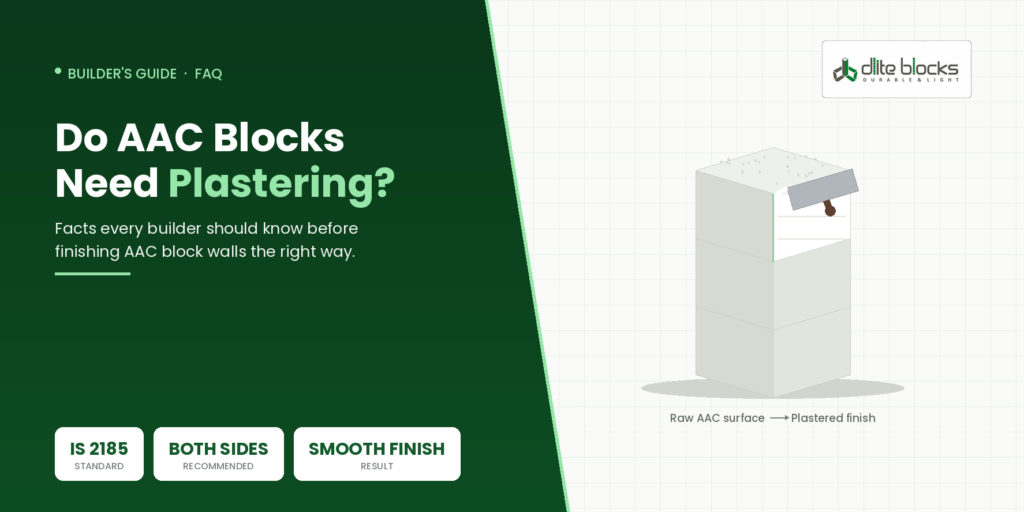
Yes, external AAC walls need a protective plaster or render finish. Smooth internal walls can often take gypsum plaster or putty with little or no cement plaster. That is the direct answer to AAC blocks need plastering. The right finish protects the wall from rain. Good fly ash blocks still need the right finishing layer.
Do AAC Blocks Need Plastering on Both Sides?
People often ask, “do AAC blocks need plastering on both sides?” The answer depends on the wall location. AAC blocks are wire cut, so they have a flat face and close size tolerance. Internal walls may need only a thin finish, but external walls need weather protection.
- For internal walls, gypsum or putty may go directly over AAC work.
- For external walls, the surface must be plastered or rendered because unplastered AAC walls absorb water during heavy rain.
- Bathrooms, balconies, and parapets need waterproof plaster with a suitable admixture.
- Do not leave exposed blockwork unfinished for months. Rain and dust make later finishing harder.
So, is plastering required for AAC block wall work? Yes for exposed faces, and optional for dry interiors. AAC Fly Ash Blocks with reliable size tolerance can reduce the internal finish you need.
Why Plaster Reacts Differently on AAC Walls
AAC has many tiny air pores. Therefore, plaster reacts differently on AAC walls than on clay brickwork. High water absorption can pull water from fresh mortar too soon. When conventional plaster loses moisture too quickly, cement hydration suffers. This causes poor bonding, cracking and delamination.
The smooth face means plaster may have difficulty adhering unless the wall is clean and prepared. Low density keeps AAC light, so avoid heavy plaster. The compressive strength of AAC matters for wall design, while higher bonding strength matters for the finish. Dry weather can bring shrinkage cracks.
Correct Plaster Thickness for AAC Block Walls
AAC blocks are dimensionally accurate, so they usually need less plaster than red bricks. The correct plaster thickness for AAC block walls depends on exposure and surface condition.
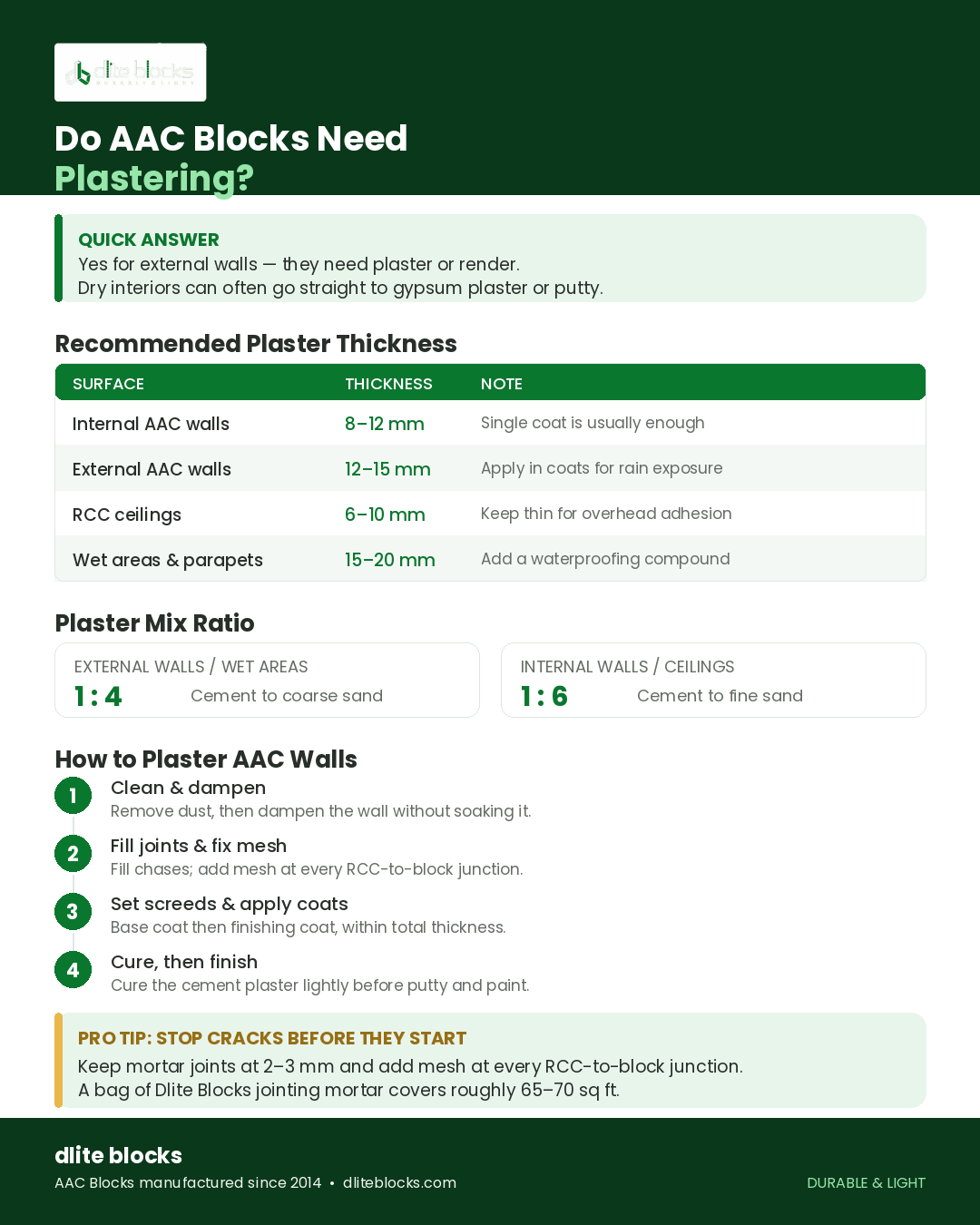
| Surface | Recommended thickness | Practical note |
| Internal AAC walls | 8-12 mm | A single coat is usually enough. |
| External AAC walls | 12-15 mm | Use coats as needed for rain exposure. |
| RCC ceilings | 6-10 mm | Keep it thin for overhead adhesion. |
| Wet areas and parapets | 15-20 mm | Add a waterproofing compound. |
For planning, use internal AAC walls 8-12 mm, external AAC walls 12-15 mm, RCC ceilings 6-10 mm, and wet areas and parapets 15-20 mm. Single coat plaster thicker than 15 mm can slump and shrink. IS 1661 covers cement and cement-lime plaster finishes. Use a base coat and finishing coat when needed. Never hide poor masonry alignment with extra plaster thickness.
Plaster Mix Ratio and Material Choices
Your plaster mix ratio should match exposure. Across Maharashtra and Madhya Pradesh, many sites use PPC or PSC cement. Sand grading also matters.
| Plaster type | Where it fits | Typical specification |
| Cement plaster | External walls, wet areas | 1:4 cement sand ratio with coarse sand |
| Cement plaster for internal walls | Internal walls, ceilings | cement mortar 1:6 with fine sand |
| Gypsum plaster | Dry interiors only | Around 12 mm; no water curing |
| Ready mix plaster | Hand or machine work | Factory graded and polymer modified |
Gypsum plaster on AAC blocks works in dry rooms and can reduce putty work. Still, gypsum is not water resistant, so keep it away from wet areas and outer faces. AAC block ready mix plaster often contains water retention additives, which help it bond properly.
How to Plaster AAC Block Walls Step by Step
Good plastering on AAC block walls follows a clear order. Here is how to plaster AAC block walls step by step.
- Clean the wall until it is dust free, then dampen it without soaking it.
- Fill AAC block joints and chases. Use a groove cutter, not a hammer.
- Fix chicken mesh or alkali-resistant fibreglass mesh where blockwork meets an RCC column or beam.
- Set screeds for level control. Apply the base coat, then the finishing coat within the total thickness.
- Cure cement plaster lightly. After drying, apply putty, primer and paint.
Correct curing and installation of AAC blocks starts before plastering. AAC block jointing mortar creates a 2-3 mm joint, which keeps courses straighter.
Why Plaster Cracks on AAC Blocks and How to Stop It
Most plaster cracks on AAC blocks begin at a joint or junction below the finish. A crazing and spider web pattern crack can return if the real cause stays.
- Thick mortar joints of 10-15 mm create differential movement.
- RCC and AAC move differently, so mesh protects the junction.
- Rich cement mortar can shrink as it dries.
- Long spans may need a bond beam or horizontal reinforcement.
Our guide on jointing mortar vs cement mortar explains thin joints. Review common site failures before repair costs grow.
Plaster Savings That Start at the Joint
Every unnecessary millimetre costs material, labour, and time. Moving from 12 mm to 15 mm increases plaster volume by about 25%. Thin joints reduce mortar consumption. A bag of Dlite Blocks jointing mortar can cover around 65-70 sq ft, depending on site handling.
Are you searching for AAC block suppliers near me before plastering starts? Dlite Blocks uses fly ash from thermal stations monitored by the Central Electricity Authority.
We supply Maharashtra and Madhya Pradesh. See our full product range.
Lightweight walling can support envelope design. The Bureau of Energy Efficiency sets Energy Conservation Building Code requirements, so confirm the full wall assembly with your consultant.
Get Walls That Hold Their Finish for Years
A crack often records a shortcut below the plaster. Keep joints thin, protect RCC junctions with mesh, use the right plaster thickness, and allow curing time.
Dlite Blocks has manufactured autoclaved aerated concrete blocks since 2014. Before plasterers arrive, talk to our team with your drawings and wall areas. We can help estimate block thickness, jointing mortar quantity, and plaster thickness.
Frequently Asked Questions
1. Does AAC Block Need Plaster on Internal Walls?
Dry internal walls often skip cement plaster when AAC blockwork is accurate. Gypsum plaster or wall putty can provide a smooth finish and save curing time.
2. What Is the Best Mix for Plastering AAC Block Walls?
Use 1:4 cement and sand for external faces and 1:6 for internal surfaces. A bonding coat can improve adhesion. Ready mix plaster can give more consistent work on large sites.
3. Can Gypsum Plaster Be Applied Directly on AAC Blocks?
Yes. The porous block face can give gypsum a mechanical key. Use a compatible bonding agent where required, and keep gypsum indoors.
4. How Do You Stop Cracks in AAC Block Plaster?
Keep joints at 2-3 mm, place mesh at RCC junctions, avoid rich mixes, and cure cement plaster. Let the finish dry before putty.
5. How Thick Should External Plaster Be on an AAC Wall?
Keep external plaster at 12-15 mm where the wall is true. Apply thicker work in coats. Too much thickness adds load and can increase shrinkage cracking.