
Most people compare building materials by one number: the price of a single piece. By that measure, a red brick looks much cheaper. But nobody pays for a single brick. You pay for a finished wall.
In this guide, we compare AAC blocks vs red bricks cost the way a builder should: for the whole wall, not just the unit.
Why Unit Price Is Misleading
An AAC block is far bigger than a brick. A standard AAC block measures 600 mm × 200 mm on its face, which is roughly equal to 12 to 14 red bricks. So a higher price per block does not mean a higher price per wall.
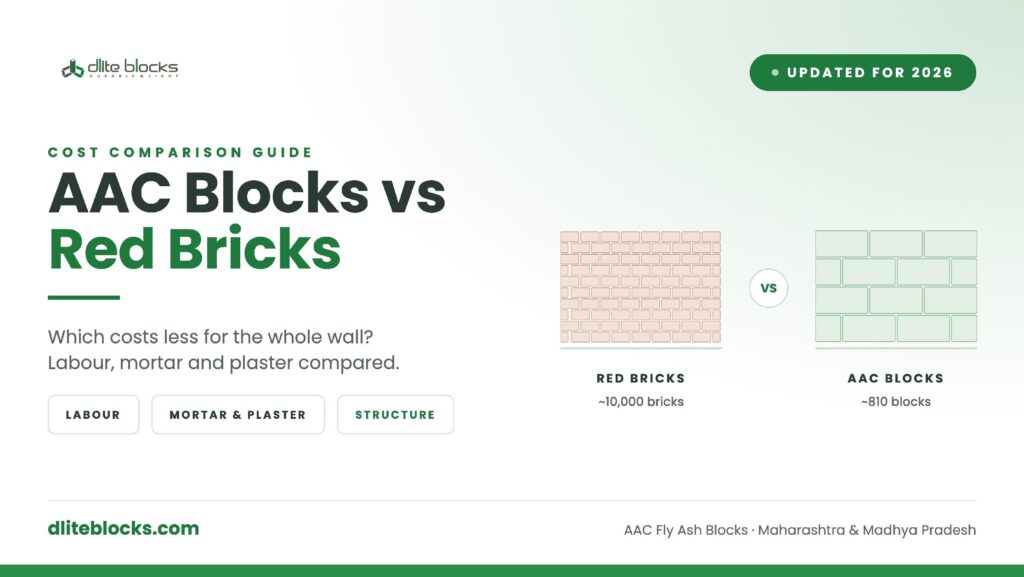
Here is a simple example. Take a 1,000 sq ft wall, which is about 93 square metres:
- AAC blocks: About 8 blocks per square metre, so roughly 775 blocks, or around 810 with 5% wastage.
- Red bricks (9-inch wall): Roughly 100 to 115 bricks per square metre, so about 10,000 bricks.
Fewer pieces means fewer hands, fewer trips and a faster job.
The Full Wall Cost Breakdown
| Cost Item | AAC Blocks | Red Bricks |
| Material price per piece | Higher | Lower |
| Number of pieces | Very few | Very many |
| Mortar needed | Low (thin joints) | High (thick joints) |
| Labour time | Less | More |
| Plaster thickness | Thinner | Thicker |
| Wall weight | Light | Heavy |
| Steel and concrete for frame | Less | More |
| Breakage and wastage | Low | Higher |
Where AAC Blocks Save Money
1. Labour
Big blocks are laid faster. A mason can finish a wall area much quicker with AAC. Our post on how AAC blocks reduce construction time and labour cost covers this in detail.
2. Mortar
Red bricks need 10 to 15 mm cement-sand joints. AAC uses a thin 3 mm layer of jointing mortar for AAC blocks. This cuts sand and cement use sharply. Readers often ask us about jointing mortar vs cement mortar, and the savings and bond strength are the main differences. If you are buying jointing mortar in Indore, check the coverage per bag so you can estimate your quantity.
3. Plastering
AAC blocks have a flat, even surface. Walls need less plaster to level them. Read more in do AAC blocks need plastering.
4. Structure
Because AAC weighs about a third of brick masonry, the building’s beams, columns and foundation carry less load. This can reduce steel and concrete cost, especially in multi-storey homes.
5. Electricity
Better insulation lowers cooling costs every month after you move in. This is a long-term saving that red bricks cannot match.
Where Red Bricks May Still Cost Less
To be fair, red bricks can be cheaper in specific situations:
- Very small jobs, like a boundary wall of a few metres.
- Areas where local brick kilns sell very cheaply and AAC transport is long.
- Projects where skilled AAC masons are unavailable.
Always compare the finished wall cost, not just the material rate.
Price Check: Aurangabad Example
Prices change by city, fuel cost and demand. If you are building in Marathwada, see our guide on AAC block price in Aurangabad to understand what moves the rate. Home builders can also read about AAC blocks for home construction in Aurangabad before planning their budget. For direct quotes, speak to a trusted AAC block manufacturer in Aurangabad. Dlite also works with AAC blocks suppliers in Aurangabad and nearby districts. Our Aurangabad page lists contact details.
In Madhya Pradesh, buyers can contact AAC block suppliers in Indore through our Indore supplier page. We also support concrete blocks manufacturer in Indore enquiries for builders comparing block types.
How to Calculate Your Own Wall Cost
Follow these steps:
- Measure your wall area in square feet or square metres.
- Divide by the face area of one block (0.12 sq m for a 600 × 200 mm AAC block).
- Add 5% for wastage.
- Add mortar, labour and plaster costs.
- Do the same for bricks and compare the two totals.
Also add the savings on structure and electricity for a complete picture.
Conclusion
When you look at AAC blocks vs red bricks cost for the whole wall, AAC often comes out equal or cheaper. Savings come from labour, mortar, plaster, structure and energy, not from the block price itself. For small walls or places with cheap local bricks, red bricks may still win. For homes and buildings where time and long-term running costs matter, AAC is usually the smarter investment.
Contact Dlite Blocks for a wall-wise quote based on your project size.
FAQs
1. Are AAC blocks cheaper than red bricks?
For a full wall, often yes. The block costs more per piece, but you save on labour, mortar, plaster and structure.
2. How many AAC blocks are needed per square metre?
About 8 blocks of 600 × 200 mm, plus around 5% for wastage.
3. Do AAC blocks save plaster cost?
Yes. Their smooth, even surface needs thinner plaster than brick walls.
4. Is jointing mortar costly?
It costs more per bag than cement mortar, but you use far less of it, so the wall cost usually falls.
5. Do AAC blocks reduce long-term costs?
Yes. Better insulation lowers electricity bills, and lighter walls reduce structural cost.