
Ask an architect in Pune, Nagpur or Chhatrapati Sambhajinagar what has quietly left their material schedule over the past five years. In many cases, the answer is red clay bricks.
The move to AAC fly ash blocks is not about following a trend. It solves practical site problems that Maharashtra projects face every day: high dead load, harsh summer heat, labour pressure and a more organised supply of fly ash.
Through the MAHAGENCO Ash Portal, Maharashtra allocates fly ash and pond ash from thermal power stations in fixed slots. Registration for the April 2026 to September 2026 allocation closed on 15.05.2026. This has made fly ash a planned construction input, not an uncertain material.
Why AAC Blocks Make More Sense on Modern Sites
The old concern was the AAC block price. Today, architects compare the full project cost, not only the rate of one unit. Red clay bricks depend on manual labour, topsoil and kiln fuel, while AAC block manufacturers in maharashtra run controlled plants with consistent output.
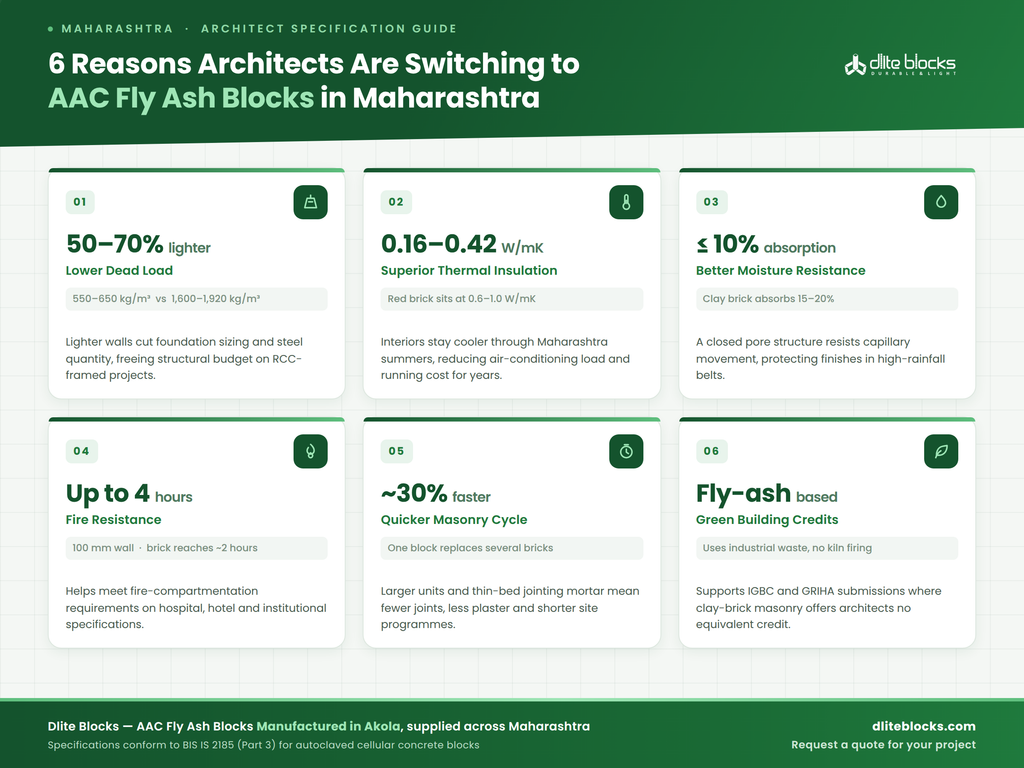
Autoclaved aerated concrete blocks also reduce the weight carried by the RCC frame. When you replace brick infill with lightweight concrete blocks, your foundations and reinforcement can become more efficient after structural approval.
You also gain clear site benefits:
- Faster construction comes from laying one large AAC block instead of 8 to 9 bricks.
- Site waste and breakage reduce because factory-made blocks arrive in uniform sizes.
- Thin bed block jointing uses less material than cement-sand mortar.
- Curing water is not needed for thin-bed jointing mortar.
- Better dry density supports cleaner frame calculations and easier handling.
AAC Blocks vs Red Bricks: What Architects Actually Compare
The AAC blocks vs red bricks decision should come from specifications, not claims. Dlite Blocks provides published figures for AAC Fly Ash Blocks.
| Parameter | AAC Fly Ash Blocks | Red Clay Bricks |
| Compressive strength | 4+ N/mm² HD, 5+ N/mm² SHD | 3.5 to 7 N/mm² |
| Dry density | 551-650 kg/m³ | About 1,800 kg/m³ |
| Thermal conductivity | Below 0.24 W/m-k | 0.6 to 1.0 W/m-k |
| Sound reduction index | 45 dB for 200mm wall | About 30 dB for 230mm wall |
| Fire resistance | 4 to 6 hours | Roughly 2 hours |
| Joint | 2-3mm joint | 10-12mm mortar |
Red clay bricks can show higher raw compressive strength. But in most framed projects, the rcc frame carries the building load and the wall remains infill. For load-bearing walls, your structural engineer must confirm grade, wall thickness and design.
Specifications That Belong in Your BOQ
IS 2185 (Part 3) is the indian standard for AAC blocks and covers autoclaved cellular concrete blocks. It sets key requirements for dimensions, density, compressive strength and water absorption.
Before choosing an AAC blocks company, check the batch data. Your BOQ and wall schedule should cover:
- Size tolerance of ±5mm in length and ±3mm in width and height.
- Dry density, because the weight of AAC blocks affects handling and dead load.
- Thermal conductivity below 0.24 W/m-k for a stronger building envelope.
- Sound reduction index for partition walls and acoustic separation.
- Fire resistance for shaft walls, fire-rated partitions and fire-rated separation.
- Water absorption, plaster details and the required block thickness.
Dlite Blocks supplies 75mm to 300mm AAC blocks. This covers internal partition walls, exterior infill, external walls and walls where thermal mass matters.
How Fly Ash Blocks Are Made in Maharashtra
Fly ash blocks use fly ash, cement, lime, gypsum and aluminum powder. The mix expands, is cut to size, and then cures in an autoclave with high-pressure steam. This process creates a non-combustible, lightweight product with a cellular structure.
Using industrial waste instead of topsoil supports eco-friendly construction. It also helps projects targeting IGBC Green New Buildings and GRIHA Ratings, or Green Rating for Integrated Habitat Assessment. Recycled fly ash content and lower cooling load can support material and energy goals without changing your design intent.
Our Bhusawal location sits close to Maharashtra’s power-generation belt. That is why fly ash AAC blocks manufacturers in bhusawal can manage input supply and freight more steadily. Dlite Blocks has worked in the AAC fly ash block industry since 2014, while our production team follows the fly ash utilization policy closely.
AAC Block Price in Maharashtra for 2026
Dlite Blocks publishes indicative rates by block size:
- 600x200x100mm, 4 inch: ₹38.50 for partition walls.
- 600x200x125mm, 5 inch: ₹48.25 for acoustic separation.
- 600x200x150mm, 6 inch: ₹58.00 for exterior infill.
- 600x200x200mm, 8 inch: ₹77.00 for external walls.
- 600x200x230mm, 9 inch: ₹87.00 where thermal mass matters.
Taxes apply as per Government of India rates. The minimum order is 32 CBM.
Use AAC block jointing mortar at ₹500 per 30kg bag. This jointing mortar for AAC blocks covers 65 to 70 sq ft at a 2-3mm joint, reaches 5 N/mm² in seven days and reduces mortar consumption. It replaces thick cement-sand mortar with a controlled thin bed application.
AAC Blocks Disadvantages You Should Plan For
AAC blocks disadvantages are real, but good planning manages them well. Edges can chip during rough handling. Wet areas need waterproof plaster or tiling. Wall fixtures need suitable fasteners, and masons may need one supervised day to understand aac block construction.
Our team supports your contractor before the first course begins. We guide curing, block jointing, fixing and plaster details so small mistakes do not turn into masonry failures.
Direct AAC Blocks Suppliers Across Maharashtra
Dlite Blocks supplies fly ash blocks in maharashtra directly from its network.
- Our AAC blocks manufacturer in Akola base has served Vidarbha since 2014.
- Projects in the Amravati belt use our AAC blocks suppliers in Amravati network.
- Marathwada projects source through our AAC block factory in Aurangabad supply line.
- Contractors also rely on AAC blocks in Jalna, AAC blocks suppliers in Dhule and AAC blocks supplier in Beed.
Hospitals, schools and commercial buildings already use our blocks, including Apple Superspeciality Hospital and Ganesh Hospital in Amalner, Jalgaon.
Specify It Once, Defend It for Decades
A material schedule stays with a project long after construction ends. With Dlite Blocks, you can support your choice with published density, strength, conductivity and fire data. Since 2014, we have delivered over 2,500 projects with 150+ trained staff.
Send us your wall schedule, size requirements and delivery programme. We will help you select the right AAC block grade and thickness. Call +91 70309 51664 or contact Dlite Blocks.
Frequently Asked Questions
1. Which is the Indian standard for AAC blocks?
IS 2185 (Part 3) covers autoclaved cellular concrete blocks. Check the supplier’s test data for compressive strength, water absorption, density and size tolerance before ordering.
2. Can AAC blocks be used for load-bearing walls?
They work best as infill in an RCC frame. For load-bearing walls, your structural engineer must approve the block grade, wall thickness and full design.
3. Are AAC blocks earthquake resistant?
Lighter walls reduce seismic mass, which reduces inertial force during an earthquake. This helps across Maharashtra’s seismic zones, although the RCC frame design still controls overall safety.
4. Do AAC blocks need special mortar?
Yes. Thin-bed jointing mortar creates a 2-3mm joint and replaces 10-12mm cement-sand mortar. It needs no curing and can reduce mortar consumption significantly.
5. How many AAC blocks are needed for a 1,000 sq ft wall?
One 600x200mm block face covers about 1.29 sq ft. A 1,000 sq ft wall needs roughly 775 blocks, plus allowance for breakage. Send us your wall schedule for an exact estimate.