
The quality control process decides whether AAC blocks reach your site with the right strength, size and consistency. At an AAC block manufacturing company, every batch moves through raw material preparation, testing, cutting, autoclaving and final inspection before dispatch.
A wall should stay stable through rain and heat, not develop cracks after the second monsoon. India generated 340.11 million tonnes of fly ash in 2024-25 and used 332.63 million tonnes, including 14% for bricks and tiles, according to the Press Information Bureau. That makes careful AAC block production more important.
Quality Control on an AAC Block Production Line
These autoclaved aerated concrete blocks form through a controlled chemical reaction. Therefore, each AAC block production line checks every stage before 3,000 AAC blocks are ready. This protects uniformity, structural integrity and wall stability.
- Slurry consistency helps the air cells form evenly.
- Rising height and green cake hardness show whether cutting can stay clean.
- Autoclave temperature and pressure, plus hold time, build final strength.
- Dimensional accuracy controls mortar use in masonry.
At Dlite Blocks, we record those readings batch by batch at our Bhusawal and Indore units. That lets us find a change in the same shift, before it affects a bulk order.
Raw Material Preparation and Incoming Checks
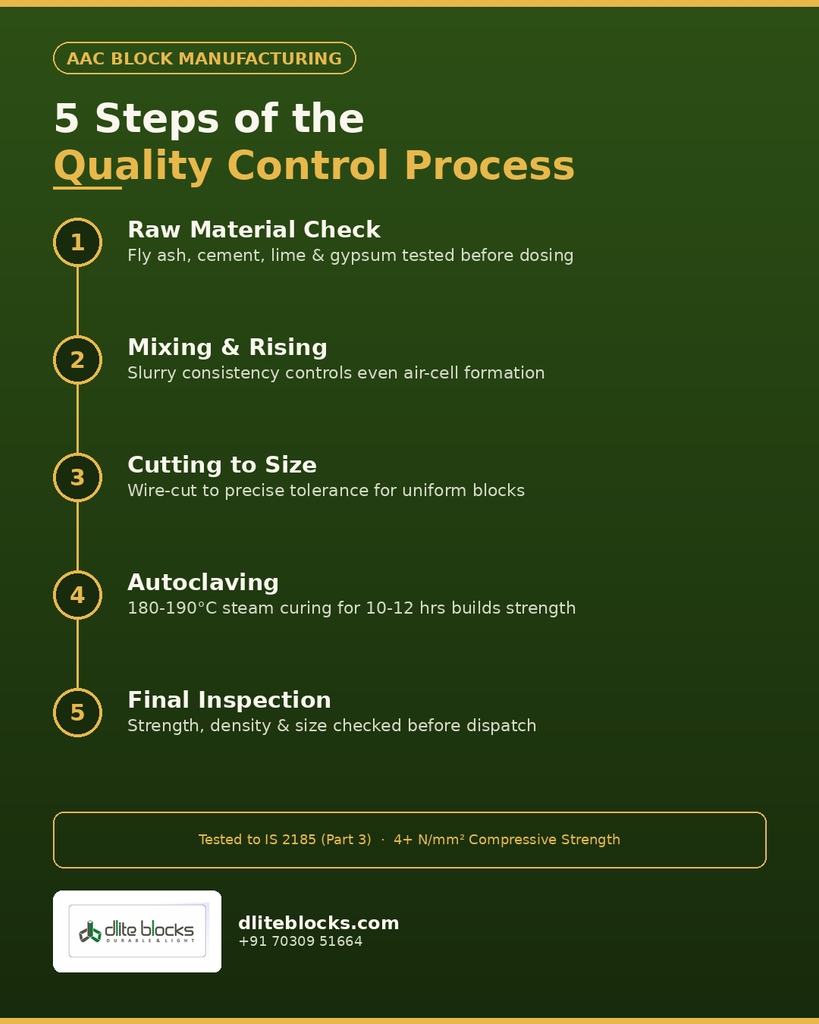
Nothing later in the production line can correct weak raw materials. So we check fly ash, ordinary portland cement, quick lime, gypsum and aluminium powder before they enter the dosing system. We test fly ash from thermal power plants for fineness and carbon content. Fresh cement, lime and gypsum support the rising stage, while aluminium powder works as the aerating agent that creates air cells. The water is kept clean and potable because its temperature affects the reaction.
Anyone comparing fly ash block manufacturers or AAC block suppliers should request these incoming records. Our AAC Fly Ash Blocks are AAC fly ash blocks that follow a fixed recipe. This helps us supply consistent fly ash blocks from one load to the next.
Stage-Wise Quality Control Process
Mixing and Dosing
During mixing and dosing, we combine fly ash slurry with cement, lime and gypsum in fixed proportions. The operator checks slurry density and slurry consistency. A thin slurry can leave large pores, while a thick slurry can increase block density and weight.
Pouring, Rising and Pre-Curing
Next, the mix is poured into moulds. Aluminium powder releases hydrogen gas, so the material rises and forms lightweight blocks. The green cake then pre-cures during pre-curing until it can hold its shape. We check rising height before de-moulding because poor rising can affect cutting and load bearing performance.
Cutting, Trimming and Size Tolerance
During cutting, steel wires slice the cake into AAC block sizes. We inspect edge chipping, trimming and uneven sizes. A dimensional tolerance check confirms dimensional accuracy and size tolerance, while a tolerance check catches wire wear early. This helps keep 600 x 200 x 100 mm and 600 x 200 x 230 mm blocks reliable for partition walls and external walls.
Autoclaving With High-Pressure Steam
The cut AAC block enters the autoclave for autoclaving and steam curing. With high-pressure steam, controlled temperature and pressure, and the correct hold time, it develops strength. The cycle usually runs 10 to 12 hours near 180 to 190 degrees Celsius. A short cycle can leave a soft block, so each charge is logged. This affects AAC block curing at the site.
Final Inspection, Sorting and Packing
After cooling, our team checks each stack before sorting and packing. We separate cracks, chipped corners, damaged edges, a powdery surface and blocks with uneven sizes for recycling. Sample blocks are weighed because weight gives a quick check on density. Approved AAC blocks are stacked on pallets and shrink wrapped to protect them during delivery.
In-House Quality Control Lab and Batch Testing
A serious AAC block factory uses an in-house quality control lab and may also send samples to a NABL accredited laboratory. The batch test report, lab report and test report give builders a clear record of testing and certification.
| Test | What it checks | Reference |
| Compressive strength in a compression testing machine | Checks load capacity in N/mm2 | IS 2185 (Part 3) |
| Oven dry density | Density class and dead load | IS 2185 (Part 3) |
| Dimensional tolerance check | Length, width and height | IS 2185 (Part 3) |
| Moisture content at delivery | Checks curing moisture before dispatch | IS 2185 (Part 3) |
| Drying shrinkage and water absorption test | Wall stability after plaster | IS 6441 |
IS 2185 Grades and AAC Block Specifications
The Indian standard for AAC blocks is IS 2185 (Part 3). It classifies autoclaved cellular aerated concrete blocks by density class and Grade 1 or Grade 2, not by brand claims. BIS licence details should match the supplier and batch. The supplied BIS listing records 279 licences.
Our Compressive strength specification is 4+ N/mm2 for HD blocks and 5+ N/mm2 for SHD blocks. HD blocks have a density of 551 to 650 kg/m3, while SHD blocks have 651 to 750 kg/m3. We maintain +/- 5 mm length and +/- 3 mm width and height tolerance, with thermal conductivity of 0.24 W/m-K.
How to Check AAC Block Quality Before You Order
Are you searching for AAC block suppliers near me? Do not choose only by the closest quote. Check these points first:
- Request the batch test report, not only a general BIS certificate.
- Check the manufacturing date and moisture content at delivery.
- Measure 5 blocks across a pallet during site inspection.
- Check for chips, unusual weight and poor surfaces before unloading.
- Confirm grades and sizes for your construction work.
You can arrange a plant visit before a bulk order with Dlite Blocks, whether you need AAC block manufacturers in Akola, an AAC block factory in Aurangabad, or AAC blocks suppliers in Indore. A tested AAC block still needs correct jointing mortar.
Our AAC block jointing mortar creates a 2 to 3 mm joint, unlike a thick sand-cement joint. Its coverage per bag is 65 to 70 sq ft per bag, helping control mortar and plaster use.
AAC Blocks Worth the Wall You Are Building
Quality control is not a brochure line. It is the autoclave chart, measuring tape and dated test report you can review. Since 2014, Dlite Blocks has served 2,500 completed projects as AAC block manufacturers across Maharashtra and Madhya Pradesh. We help builders choose an eco-friendly building material for a housing tower, hospital block or warehouse, with delivery windows.
Planning your next project? Talk to our manufacturer and supplier team about grades, sizes and delivery windows. You can also see the projects already standing or send your requirement to our team. Call +91 70309 51664, and we will include the current batch test report with your quote.
Frequently Asked Questions
1. What is the main purpose of quality control in AAC block production?
It keeps strength, density and size within the same range from one batch to the next. As a result, the structure stays stable and plaster use remains easier to plan.
2. Which IS code governs AAC blocks in India?
IS 2185 (Part 3) covers AAC blocks, while IS 6441 covers relevant test methods. Check the density class and grade shown for your batch.
3. How is temperature controlled during autoclaving?
Sensors record the full temperature and pressure cycle. If a reading moves outside the set range, the team reviews it before releasing the charge.
4. What tests are conducted on AAC blocks?
The main tests include compressive strength, oven dry density, dimensional tolerance, moisture content, drying shrinkage and water absorption test. A NABL accredited laboratory report can support site requirements.
5. How can I spot a poor quality AAC block on site?
Look for uneven sizes, chipped edges, cracks, a powdery surface or unusual weight. Then measure sample blocks and request the batch test report before unloading.