
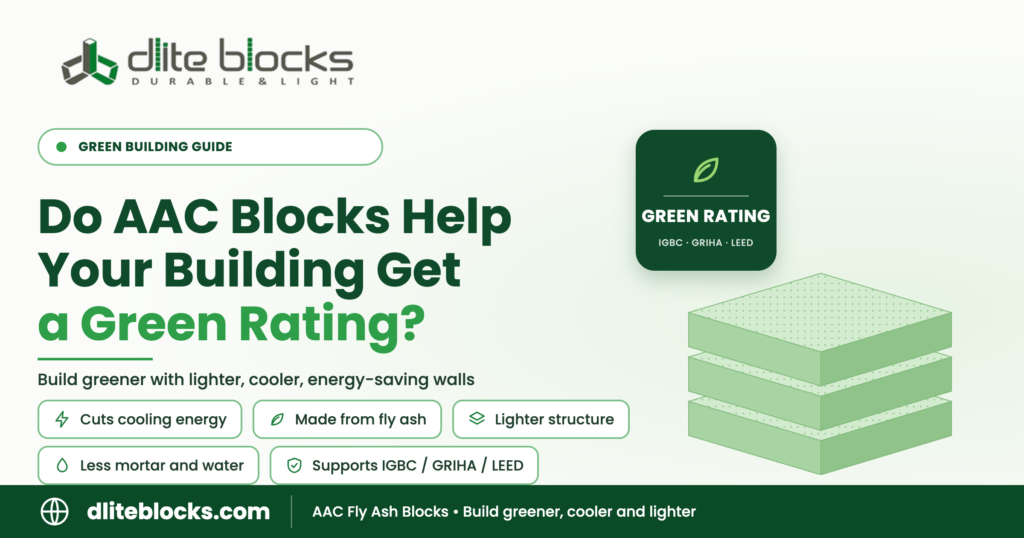
Green buildings are no longer a luxury. Buyers want lower electricity bills, developers want better resale value, and cities want less pollution. One question comes up again and again on site: do AAC blocks for green building rating actually help?
The short answer is yes. AAC blocks cannot earn a certificate on their own, but they contribute to several credit categories under IGBC, GRIHA and LEED. This guide explains how, in plain language.
What Is a Green Building Rating?
A green building rating is a score given to a building for how responsibly it is designed, built and operated. In India, the most common systems are:
- IGBC (Indian Green Building Council)
- GRIHA (Green Rating for Integrated Habitat Assessment)
- LEED (Leadership in Energy and Environmental Design)
Each system gives points for energy saving, water saving, recycled content, local materials and lower waste. Walls affect many of these areas, so wall material matters.
What Is an AAC Block?
An AAC block (Autoclaved Aerated Concrete block) is a light, cellular block. It is made from fly ash, lime, cement, gypsum and a small amount of aluminium powder. The mix rises like dough and is then cured in a high-pressure steam chamber called an autoclave. Millions of tiny air pockets form inside the block. These pockets give AAC its two best qualities: it is light and it insulates well.
In Maharashtra, you may also hear AAC blocks called a Siporex block in Maharashtra. Siporex is a well-known trade name, and the product is the same type of material.
5 Ways AAC Blocks Support a Green Rating
1. They Reduce Cooling Energy
Trapped air makes AAC a poor conductor of heat. Walls stay cooler in summer and warmer in winter, so air conditioners work less. Energy performance carries the highest weight in most rating systems. You can read more in our post on the thermal insulation of AAC blocks.
2. They Use Industrial Waste
Fly ash is a by-product of thermal power plants. Using it in blocks keeps it out of landfills and ponds. This earns credit under recycled-content and waste-reduction categories. Builders searching for fly ash blocks in Maharashtra are choosing exactly this benefit. Our guide on why our AAC blocks are made from fly ash explains the process.
3. They Lower Transport and Structural Load
AAC blocks weigh roughly one-third as much as clay brick masonry. A lighter building needs less steel and concrete in its frame. Less material also means fewer truck trips and lower embodied carbon.
4. They Need Less Water and Mortar on Site
Large blocks mean fewer joints. With jointing mortar, joints are only a few millimetres thick, compared with the thick cement-sand joints used with bricks. This saves sand, cement and water, which supports resource-efficiency credits.
5. They Help Protect the Land
Red clay bricks are made by digging topsoil and burning it in kilns that release smoke and carbon. AAC avoids both. Many municipal bodies and green projects now prefer AAC for this reason.
Quick Comparison
| Green Factor | AAC Blocks | Red Clay Bricks |
| Heat insulation | High | Low |
| Uses recycled fly ash | Yes | No |
| Topsoil used | No | Yes |
| Weight on structure | Light | Heavy |
| Mortar and water use | Low | High |
What AAC Blocks Cannot Do Alone
It is important to be honest here. A rating depends on the whole building: lighting, plumbing, solar, landscaping and more. AAC blocks help with materials and energy credits, but you still need a green consultant to document the points. Always ask your manufacturer for test reports, fly ash content details and BIS compliance documents, since you will need them for submission.
Where to Buy Green-Ready AAC Blocks
Choosing a reliable plant matters as much as choosing the material. Dlite Blocks supplies across Maharashtra and Madhya Pradesh. If you want an AAC block manufacturer in Maharashtra with documented quality control, see how we work in our quality control article. Projects in central India can also look at fly ash block manufacturers in Madhya Pradesh. Dlite serves both regions. Good AAC block construction starts with consistent block size and strength, and both come from controlled manufacturing.
Conclusion
AAC blocks for green building rating are a smart choice. They save energy, reuse fly ash, reduce structural weight and cut site waste. These benefits map directly to credit categories in IGBC, GRIHA and LEED. While blocks alone will not guarantee a certificate, they give your project a strong head start and lower running costs for years.
If you are planning a green project, talk to the Dlite team for specifications, test reports and project support.
FAQs
1. Do AAC blocks help in getting IGBC points?
Yes. They can support points in energy efficiency, recycled content and material efficiency. The exact number depends on your project design.
2. Are AAC blocks eco-friendly?
Yes. They use fly ash, need no topsoil, and improve a building’s energy performance.
3. Can AAC blocks alone give a green certificate?
No. A certificate needs the full building to meet standards, but AAC blocks contribute strongly to the material and energy sections.
4. Is Siporex the same as AAC block?
Siporex is a trade name for AAC. Both refer to autoclaved aerated concrete blocks.
5. Do AAC blocks reduce electricity bills?
Yes. Their insulation reduces heat entering the building, so cooling costs usually fall.