
Two blocks can look the same on a pallet but perform very differently after masonry begins. That difference starts inside the AAC block factory in Akola, long before the truck reaches your site.
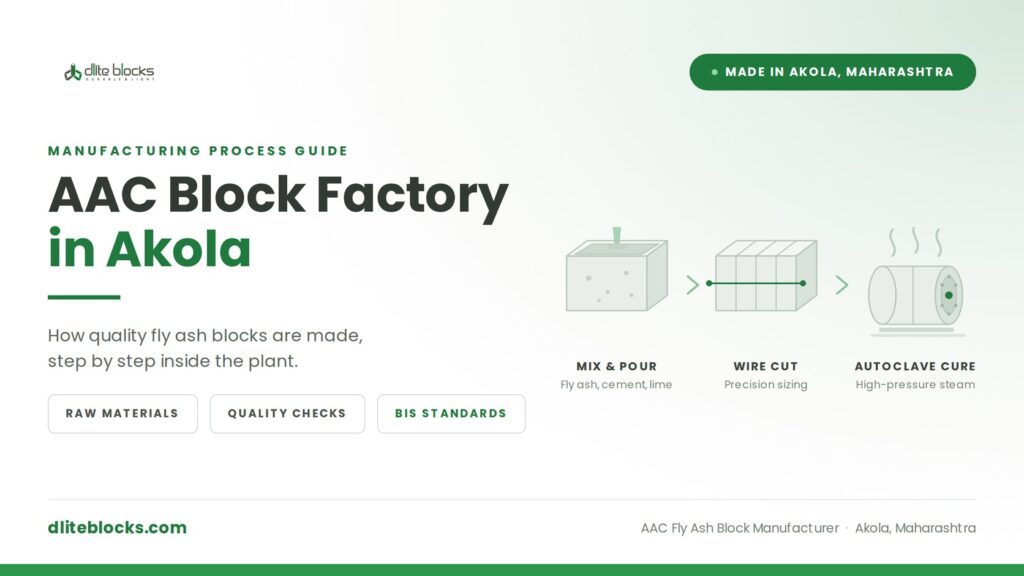
Quality AAC blocks are made from fly ash, cement, lime, gypsum, water, and aluminium powder. We turn them into a slurry, allow it to rise into a green cake, cut it accurately, and cure it in an autoclave. This manufacturing process creates true autoclaved aerated concrete blocks, not lightweight concrete blocks that were simply left to dry.
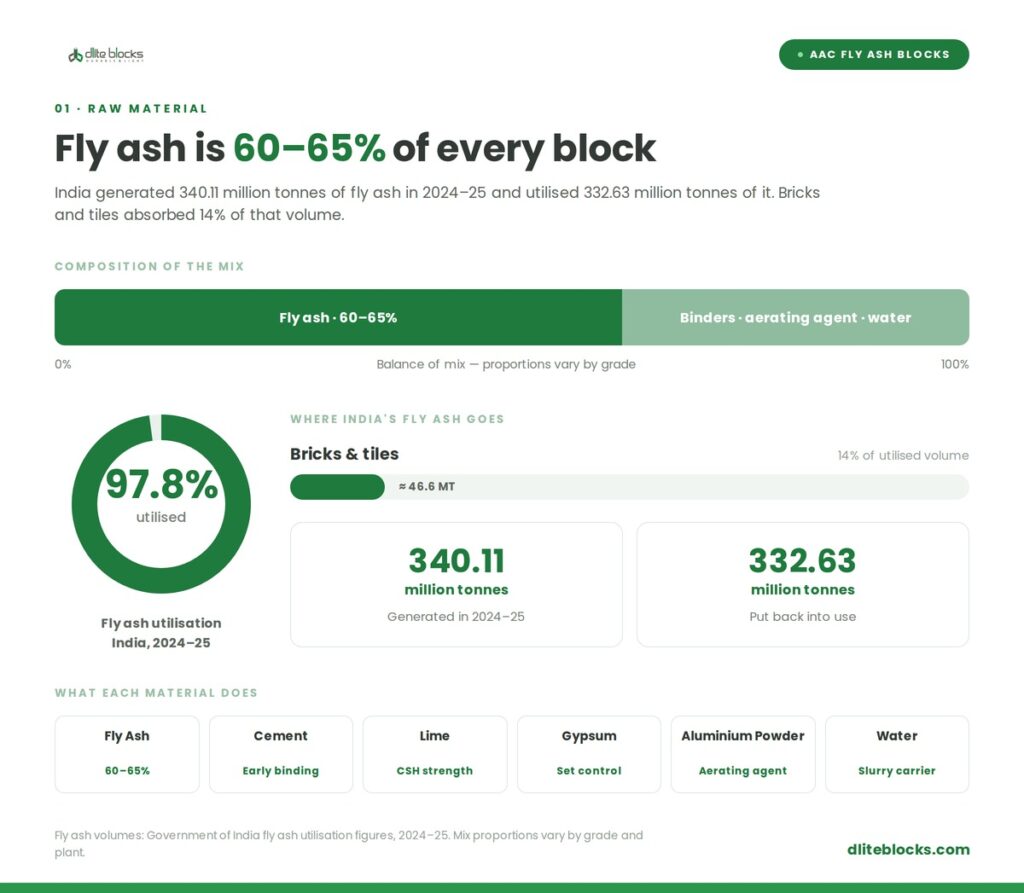
India generated 340.11 million tonnes of fly ash in 2024-25 and used 332.63 million tonnes of it. Bricks and tiles used 14% of that volume, according to the government’s fly ash utilisation figures. At our AAC block factory in Akola, Dlite Blocks uses this resource to produce reliable walling material for AAC block construction.
What Goes Into Quality AAC Blocks?
A good AAC block needs a controlled recipe. Each material affects strength, weight, thermal insulation, and dimensional accuracy.
- Fly ash forms about 60-65% of the mix. It provides silica and supports the reaction that makes the block stable.
- Cement provides early binding strength before autoclaving.
- Lime reacts with silica and forms calcium silicate hydrates, which support long-term strength.
- Gypsum controls setting time, so the mix firms evenly.
- Aluminium powder releases hydrogen gas. This creates the porous structure that makes AAC blocks lightweight.
- Water carries the materials into a smooth slurry for mixing and casting.
Fly ash quality matters as much as the formula. Coarse ash or ash with high unburnt carbon can affect strength and finish. Our fly ash blocks in Maharashtra come from our manufacturing unit at Bhusawal, near the Deepnagar power plant. The source remains close and controlled, while ash utilization reports remain publicly available.
This helps us supply steady-grade fly ash blocks to Akola and nearby markets. The Paras thermal power plants also sit within this ash belt, which supports dependable sourcing for an AAC block factory in Akola.
Inside Our AAC Block Manufacturing Plant
Dosing and Mixing
Fly ash is ground with water into a slurry. Cement, lime, and gypsum sit in silos, then screw conveyors feed them into the mixer at measured levels. Proper dosing and mixing keep every batch consistent.
That is where an organised AAC block factory in Akola differs from a small unit working without batch control. A proper AAC block plant does not guess its proportions.
Casting, Rising and Pre-Curing
We pour the slurry into oiled moulds. Aluminium powder reacts with lime and water, releasing hydrogen gas. The mix rises and fills the mould, much like dough rising before baking.
The green cake then enters pre-curing. It rests for a few hours until it becomes firm enough for wire cutting, while still soft enough to cut without breaking.
Wire Cutting and Size Tolerance
Wire cutting controls the dimensional accuracy of an AAC wall block. Good cutting keeps the size tolerance close to ±3 mm.
That accuracy gives you real site benefits:
- Masons can use 2-3 mm joints with a thin-bed adhesive.
- Courses stay level and neat.
- Plaster thickness stays lower.
- You avoid rejection, breakage, and uneven wall lines.
AAC blocks for construction work best when their size stays consistent from one pallet to the next.
Autoclaving for Final Strength
After cutting, blocks move into the autoclave. This sealed chamber uses steam at around 12 bar and 180-190°C for 10-12 hours.
During autoclaving, lime and silica form tobermorite crystals. This is the stage that gives an autoclaved aerated concrete block its final compressive strength, dry density, and stability. Without this step, you do not get genuine autoclaved aerated blocks.
Grade, Strength, and Quality Testing
IS 2185 helps buyers understand grade through density and strength. We carry out quality testing before packing and dispatch.
| Specification | Dlite Standard |
| Compressive strength | HD 4+ / SHD 5+ N/mm² |
| Dry density | HD 551-650 / SHD 651-750 kg/m³ |
| Thermal conductivity | Under 0.24 W/m-K |
| Sound reduction index | 45 dB for a 200 mm wall |
| Fire resistance | 4-6 hours, based on thickness |
| Sizes | 600x200x75 to 300 mm |
Density and strength usually move together. If a block feels unusually light for its claimed grade, ask for its test report. Our compressive strength guide explains what to check.
Dlite Blocks openly lists product data for AAC fly ash blocks. Whether you need load-bearing walls, partition walls, infill panels, or framed structures, choose the grade for the actual job.
AAC Blocks vs Red Bricks
| Factor | AAC Blocks | Red Bricks |
| Weight | Lightweight, about one-third of brick weight | Heavy |
| Wall speed | Larger units and fewer joints | Slower masonry |
| Thermal insulation | Better | Lower |
| Acoustic performance | Better sound control | Lower |
| Dead load | Lower | Higher |
| Structure | Can reduce steel and concrete demand | Adds more structural load |
The lower dead load matters because it affects the full structure, not only the wall. Do not compare only AAC blocks price with fly ash brick price or red brick rates per piece. Compare the finished wall. Our AAC blocks vs red bricks guide makes that comparison easier.
How to Check an AAC Block Factory Before Ordering
Before choosing an AAC block supplier, ask direct questions:
- Where does the fly ash come from, and how far does it travel?
- What autoclave cycle do they follow? A serious process uses about 10-12 hours at 12 bar.
- Can they show batch records for dry density and compressive strength?
- Do they provide a compatible AAC block mortar and Jointing Mortar?
Blocks with a ±3 mm finish deserve AAC block jointing mortar in Akola, not thick cement-sand beds. Our AAC block jointing mortar works as jointing mortar for AAC blocks, offers block jointing mortar coverage of 65-70 sq.ft per bag at 2-3 mm joints, needs no curing, and can reduce mortar consumption by up to 70%.
For builders, choosing both AAC blocks and Jointing Mortar from one maker means one team stays answerable for the wall system.
AAC Blocks in Akola and Maharashtra
Dlite Blocks is an AAC block manufacturing company with ten years in business, 2.5k projects completed, and 150+ trained staff. Apple Superspeciality Hospital and Ganesh Hospital Amalner used our blocks, where fire resistance and acoustic performance matter every day.
Builders across Akola, Amravati, and Aurangabad can order from us as AAC bricks manufacturers, AAC blocks manufacturers, fly ash block manufacturers, and AAC blocks suppliers.
Ready to Order AAC Blocks?
If you need AAC blocks suppliers in Akola, send us your drawing, block size, and required CBM. Our AAC blocks manufacturer in Akola team works from Damle Chowk, Ramdaspeth, from 9 am to 10 pm, seven days a week.
Call 7030951664 or contact us. We will help you choose the right AAC block grade, quantity, and delivery plan.
Frequently Asked Questions
1. What is the minimum order quantity for AAC blocks in Akola?
Dlite Blocks supplies from a minimum of 32 CBM per order. It suits residential slabs, commercial partition walls, and bulk site work.
2. Are AAC blocks and Siporex blocks the same thing?
Yes. Siporex blocks are an older brand name widely used in Maharashtra for autoclaved aerated concrete blocks in Akola and other markets.
3. What is the AAC block price per block in Akola?
Indicative AAC blocks price starts around ₹38.50 for a 100 mm block and goes up to ₹87.00 for a 230 mm block, before taxes. Final AAC block price depends on quantity, size mix, and delivery distance.
4. Do AAC blocks need plaster and curing like red bricks?
AAC blocks laid with AAC block jointing mortar need no curing at the joint. Their flat surface can also reduce plaster thickness.
5. Which grade suits load-bearing work?
Use SHD grade at 5+ N/mm² for load-bearing work. HD grade at 4+ N/mm² suits partition walls and infill panels in framed structures.