
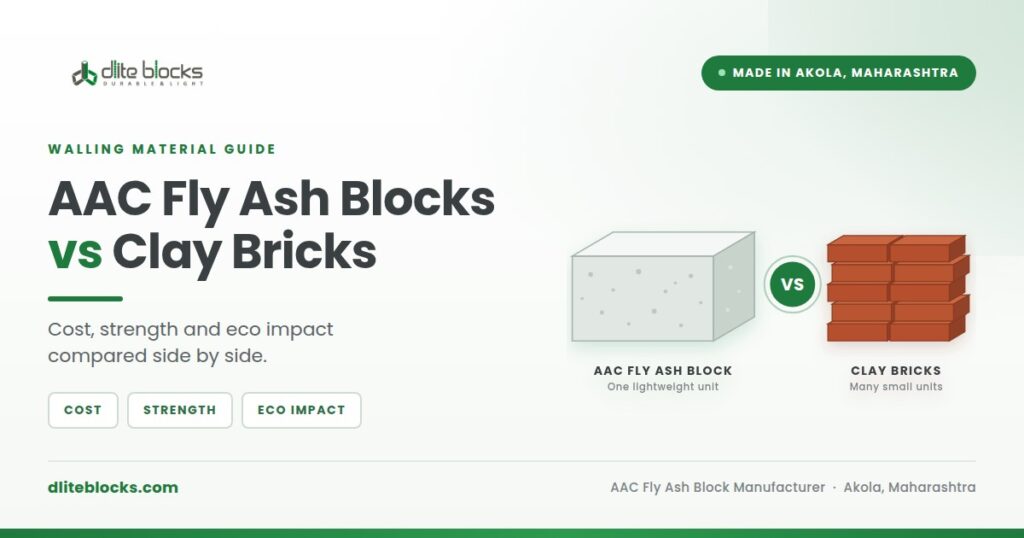
Picking your wall material is one of the first big choices on any site, and it quietly decides your budget, your build speed, and how the home feels to live in later. When comparing fly ash blocks vs clay bricks, which one is better? For most homes and buildings in 2026, AAC fly ash blocks win on total cost, weight, and energy savings, while clay bricks hold only a small lead in raw strength for pure load-bearing walls.
Here is a simple fact that shows why the switch is happening so fast: using fly ash blocks can cut the embodied energy of a wall — the total energy it takes to make and build it — by up to 90%. Below, we explain cost, strength, and eco impact in very plain words, so you can decide clearly between fly ash blocks vs clay bricks.
What Are AAC Fly Ash Blocks and Clay Bricks?
Once you know how each one is made, almost every difference later starts to make sense.
- AAC fly ash blocks are light autoclaved aerated concrete units made from fly ash, lime, cement, and a little aluminium powder, then steam-cured until nearly 80% of the block is just trapped air.
- Clay bricks are the red bricks you already know, shaped from fertile topsoil and baked in coal or wood kilns, which is why they stay heavy and keep eating into farmland.
- Fly ash blocks and autoclaved aerated concrete blocks are the same thing, and both follow IS 2185 quality rules, while small-kiln bricks change from one batch to the next.
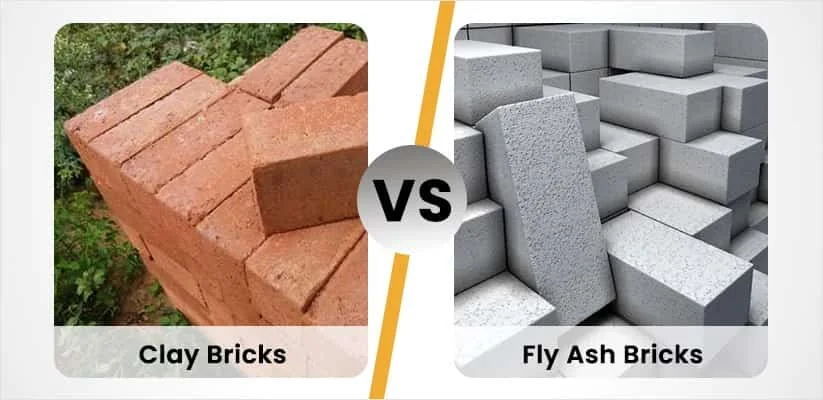
AAC Fly Ash Blocks vs Clay Bricks: Full Comparison
This table puts the real specs of Dlite Blocks next to normal red clay bricks, so you can see the gap in one glance.
| Property | AAC Fly Ash Blocks (Dlite) | Clay Bricks |
| Size | 600 x 200 x 75 to 300 mm | 230 x 110 x 75 mm |
| Weight | 3 to 4 times lighter, 50% less dead load | Heavy |
| Compressive strength | 4+ N/mm² (HD), 5+ N/mm² (SHD) | 2.5 to 3.5 N/mm² |
| Dry density | 551 to 750 kg/m³ | 1600 to 1920 kg/m³ |
| Water absorption | around 10% | 15 to 20% |
| Thermal conductivity | 0.24 W/mK | 0.6 to 1.0 W/mK |
| Fire resistance | 4 to 6 hours | 1 to 2 hours |
| Sound reduction | up to 45 dB | lower |
| Eco impact | recycles fly ash, saves topsoil | burns fuel, digs topsoil |
| Indicative price | around ₹38.50 per block | ₹6 to 10 per brick |
Cost Comparison in India (2026)
This is where a lot of people get fooled, because they only look at the price of one unit. A clay brick may cost ₹6 to 10, and an AAC block price sits a bit higher per piece, but the number that really decides your budget is the finished cost of the whole wall. Once you add everything up, AAC fly ash blocks usually make the wall cheaper. In our own supply runs across Maharashtra and Madhya Pradesh, one 600 x 200 x 200 mm block takes the place of roughly 8 handmade bricks, and that single fact is where most of your saving quietly hides.
- You lay far fewer units, since one block does the job of 6 to 8 red bricks, so your wall goes up much faster.
- Your foundation and frame carry less weight, which means you buy less steel and concrete on taller buildings.
- Your smooth block faces need very little plaster, and the thin joints use less mortar, so your material bill keeps dropping.
- You pay a lower fly ash brick price on materials and less on labour, and together they pull the whole AAC block construction cost down.
Are you looking for a reliable AAC blocks supplier in Indore or an AAC block factory near your site? The Dlite Blocks team shares clear, honest rates on its AAC Fly Ash Blocks range before you place a single order.
Strength, Weight and Durability
On paper, well-baked clay bricks show slightly higher raw strength, so they still suit small load-bearing walls. But most buildings today use an RCC frame, where the columns and beams carry the weight and the walls only fill the gaps. For that job, the 4+ N/mm² strength of AAC blocks is more than enough, and the light weight actually helps the whole structure stay safe.
- The low weight of AAC blocks cuts dead load, so your building feels less stress in an earthquake, which really matters in seismic zones.
- Your blocks stay the same size every time, so walls crack far less and stay nice and straight for years.
- Your walls resist termites, mould, and fire, so you spend much less on repairs and repainting later.
Every Dlite Blocks batch is sorted as HD or SHD grade, so you know its compressive strength before it ever reaches your site, something loose kiln bricks can never promise you.
Eco Impact and Energy Savings
This part now decides more and more tenders, and it is the clearest win for blocks. Every clay brick starts by scraping off fertile topsoil and then burning fuel in a kiln, which dirties the air and slowly ruins good farmland. AAC fly ash blocks turn that story around, because they reuse factory waste instead of digging up soil.
- Fly ash from thermal power plants gets recycled into strong walls, instead of being dumped in landfills near your city.
- No topsoil is scraped away, so the farmland and the environment around your project stay safe.
- The low 0.24 W/mK thermal conductivity keeps your rooms cooler in summer and warmer in winter, all on their own.
That insulation trims your air-conditioning and heating bills every month, which is the exact energy savings the Bureau of Energy Efficiency keeps asking Indian buildings to aim for. Dlite Blocks is proud to help builders around Aurangabad and Madhya Pradesh build greener without paying more.
Faster Construction and the Jointing Mortar Advantage
Time on site is money, and blocks pull ahead here too. Because each unit is bigger and lighter, your masons lay fewer of them and finish walls about 20% faster than with small bricks. The real trick, though, is the glue you use to hold them together.
- AAC block jointing mortar is a ready-to-use thin-bed glue that bonds blocks with joints of just 2 to 3 mm.
- One 30 kg bag covers about 65 to 70 sq ft and saves up to 70% of the mortar that an old cement-sand mix would waste.
- No curing and no on-site guesswork, so your walls come out cleaner, stronger, and more even every time.
Pair your blocks with the right AAC block jointing mortar from Dlite Blocks, and you finally get the full speed these walls are built for.
Which Should You Pick for Your Build?
Both materials still have a place, so match the choice to your project, not to old habit.
- Choose AAC fly ash blocks for apartments, offices, schools, hospitals, and any RCC or high-rise work where speed, insulation, and low weight matter to you.
- Choose clay bricks only for small, low-budget, load-bearing rural structures where your masons have no block training yet.
- If you buy in volume as a builder, dealer, or architect, block supply gives you steadier quality and easier planning than kiln bricks ever will.
As one of the trusted AAC block manufacturers in India, Dlite Blocks serves both B2B contractors and everyday homeowners, from Akola to Indore.
Build Lighter, Stronger, and Greener with Dlite
Your walls carry the whole building for decades, so the smart move is the one that saves money every year, not just on day one. Between AAC fly ash blocks and clay bricks, the blocks give you faster construction, cooler rooms, safer structures, and a lower total cost. Dlite Blocks brings you factory-graded lightweight concrete blocks, matching block jointing mortar, and steady supply from its own units, so nothing on your site ever stalls. Whether you are planning one house or ordering by the truckload, we would love to help you pick the right blocks for the job. Get in touch with our team or call 7030951664, and let us make your next build stronger and greener.
FAQs
Are AAC fly ash blocks stronger than clay bricks?
For framed buildings, yes. AAC fly ash blocks give 4+ N/mm² compressive strength, which is plenty for infill walls, and their light weight adds extra safety in earthquakes.
Is the AAC block price higher than clay bricks?
Per unit, slightly higher. But once you add plaster, mortar, steel, and labour, the total wall cost of AAC blocks usually ends up lower than clay bricks.
Do AAC fly ash blocks absorb water?
They soak up around 10%, far less than the 15 to 20% of clay bricks. A proper outer plaster keeps your walls dry through the monsoon.
Which is more eco-friendly for construction?
AAC fly ash blocks, clearly. They recycle fly ash and save topsoil, while clay bricks burn fuel in kilns and strip away fertile soil.
Where can I find AAC block suppliers near me in Maharashtra or MP?
Dlite Blocks supplies AAC fly ash blocks and jointing mortar across Akola, Amravati, Aurangabad, Jalna, and Indore, with direct rates for builders and homeowners.