
Picking the wrong AAC block size can cost you money, space and strength. Walls that are too thick waste floor area. Walls that are too thin may crack or fail to insulate well.
This guide explains each AAC block size in simple terms, so you can choose the right one for every wall in your building.
Standard AAC Block Dimensions
Most AAC blocks in India share the same face size. The thickness is what changes.
- Length: 600 mm (about 24 inches)
- Height: 200 mm (about 8 inches)
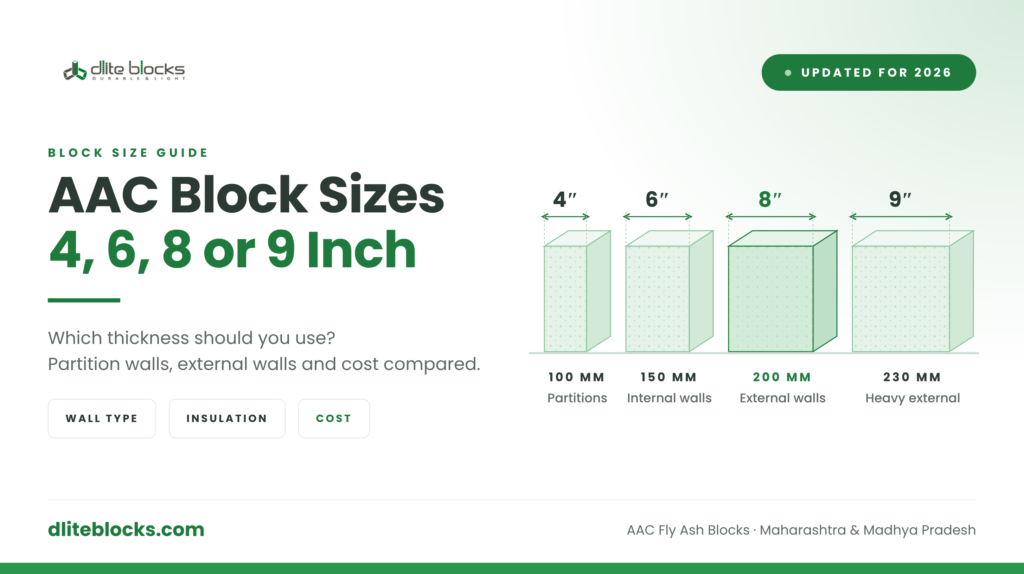
- Thickness: 100, 150, 200 or 225/230 mm (4, 6, 8 or 9 inches)
Available sizes can vary by plant, so confirm stock with your supplier before you finalise your drawings.
Quick Answer Table
| Thickness | Best Use | Key Benefit |
| 4 inch (100 mm) | Light partitions, non-load walls | Saves floor space |
| 6 inch (150 mm) | Inner walls, partitions | Good balance of cost and strength |
| 8 inch (200 mm) | External walls, most common | Strong and well insulated |
| 9 inch (225/230 mm) | Outer walls needing extra protection | Best insulation and sound control |
4-Inch AAC Blocks
These are the thinnest blocks. Use them for non-load-bearing partitions inside rooms, such as dividing walls between a bedroom and a dressing area.
Pros: light, cheap, and they save carpet area.
Cons: limited sound and heat insulation. They are not suitable for outer walls.
6-Inch AAC Blocks
A popular choice for internal walls between rooms. They give better sound control than 4-inch blocks and still keep walls slim.
Pros: balanced cost, good for bedrooms and living areas.
Cons: not ideal for outer walls that face heavy sun or rain.
8-Inch AAC Blocks
This is the most widely used size for external walls in homes and apartments. It offers a strong balance of insulation, strength and cost.
Pros: good heat resistance, solid structure, ideal for most houses.
Cons: slightly more wall thickness than 6-inch.
9-Inch AAC Blocks
This size suits outer walls where you want extra protection from heat, noise or weather. It is often used in hot regions, or on top floors and building edges.
Pros: highest insulation and sound reduction.
Cons: uses more floor area and costs more.
How to Choose the Right Size: 4 Simple Steps
- Decide the wall type. Is it internal or external?
- Check the structure. Most modern buildings use an RCC frame with AAC as infill. For structural questions, see AAC blocks for load-bearing vs framed structures.
- Think about climate. Hot regions benefit from thicker external walls. Read about how AAC blocks improve energy efficiency in buildings.
- Ask your structural engineer. The engineer’s drawing always comes first.
How Many Blocks Do You Need?
The block face is 600 × 200 mm, or 0.12 sq m. So you need about 8 blocks per square metre of wall, for any thickness. Add around 5% for cutting and wastage.
For example, a 20 sq m wall needs about 167 blocks, or 175 with wastage.
Don’t Forget the Jointing Mortar
Block size and mortar go together. AAC blocks are laid with a thin layer of jointing mortar for AAC blocks. Coverage depends on block thickness, because thicker blocks need more mortar per course. If you are planning a project in central India, ask about block jointing mortar coverage in Madhya Pradesh, so you can order the right number of bags. Builders in Bhopal can also source jointing mortar in Bhopal along with their blocks.
Common Mistakes When Choosing Block Size
- Using 4-inch blocks for external walls to save money.
- Choosing 9-inch blocks everywhere and wasting floor space.
- Mixing thicknesses on one wall, which creates uneven finish.
- Ordering blocks before final drawings are approved.
- Ignoring local climate and weather exposure.
Quality Matters as Much as Size
A correct size means little if the block is uneven or weak. Check dimensional accuracy, density and strength. Our guide on how to test AAC block compressive strength shows what to look for. Also learn how AAC fly ash blocks are manufactured to understand why consistent size depends on controlled production.
Where to Buy
Builders in Madhya Pradesh often search for AAC bricks manufacturers in Indore. You can see our local details on the Indore AAC block manufacturers page. We also receive enquiries from concrete blocks manufacturer in Indore searches, where buyers want to compare AAC with other blocks. For other cities, you can contact Dlite as an AAC blocks supplier in Bhopal, or ask about AAC blocks suppliers in Ujjain for delivery to your site.
Conclusion
Choosing the right AAC block size is simple once you match thickness to wall type. Use 4-inch and 6-inch blocks for internal partitions, 8-inch for most external walls, and 9-inch where you need extra insulation. Always follow your engineer’s drawing, buy blocks and jointing mortar together, and choose a supplier with consistent quality.
Share your wall plan with the Dlite team and we will help you calculate quantity and size.
FAQs
1. Which AAC block size is best for external walls?
8-inch (200 mm) is most common. 9-inch is used where extra insulation is needed.
2. Can I use 4-inch AAC blocks for outer walls?
No. They are meant for light internal partitions only.
3. How many AAC blocks are needed per square metre?
About 8 blocks of 600 × 200 mm, regardless of thickness.
4. Does a thicker AAC block insulate better?
Yes. Greater thickness improves heat and sound insulation.
5. Are all thicknesses available at every plant?
Not always. Confirm stock and sizes with your supplier before finalising the plan.