
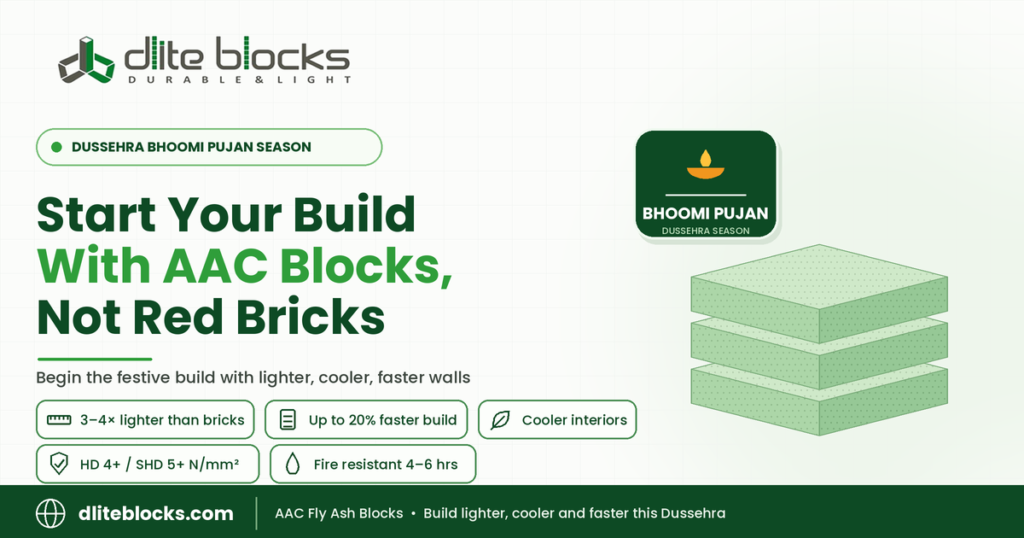
Dussehra is one of the most auspicious days in the Indian calendar to begin something new. For thousands of families, that means Bhoomi Pujan, the ceremony that marks the first step of building a home. Before the first foundation trench is dug, one decision will shape your home for decades: the wall material.
For most new homes, AAC blocks are a smarter starting point than red bricks. They are 3–4 times lighter, quicker to install and better at keeping interiors cool. Dlite Blocks manufactures AAC fly ash blocks at its plants in Bhusawal and Indore.
Why Decide on the Wall Material Before Bhoomi Pujan?
Once the ceremony is over, work moves fast. Choosing your walling material early lets your architect and structural engineer design around it. The material affects dead load, wall thickness, plaster quantity and finishing schedule.
AAC Blocks vs Red Bricks: What Actually Changes
Weight. According to Dlite’s AAC Fly Ash Blocks specifications, these blocks are 3–4 times lighter than traditional red bricks. Nearly 80% of the block’s volume is air. Lighter walls reduce the overall dead load of a building.
Speed. Larger blocks mean fewer joints in the masonry. Dlite states that its blocks can reduce construction time by around 20%, and lighter blocks are easier to handle on site.
Comfort. Tiny air pores give AAC excellent thermal insulation. This keeps interiors cooler in summer and warmer in winter, and can reduce air-conditioning costs. The blocks also offer acoustic insulation, with a Sound Reduction Index of 45 dB for a 200 mm wall.
Safety. AAC is non-combustible. Dlite lists fire resistance of 4–6 hours depending on wall thickness. The blocks are also termite-resistant.
Sustainability. Red bricks consume fertile clay. Dlite blocks use fly ash, a by-product of thermal power plants, along with lime, cement and aluminium powder.
Choose the Right Thickness for Each Wall
Dlite blocks are available in these sizes (length × height × thickness):
- 600 × 200 × 100 mm (4 inch)
- 600 × 200 × 125 mm (5 inch)
- 600 × 200 × 150 mm (6 inch)
- 600 × 200 × 200 mm (8 inch)
- 600 × 200 × 230 mm (9 inch)
Thinner blocks suit partition walls. Thicker ones suit external walls. Custom sizes are also possible.
Don’t Forget the Jointing Mortar
AAC blocks perform best with thin-bed mortar rather than traditional thick sand-cement joints. Dlite’s AAC Fly Ash Blocks Jointing Mortar helps blocks align well and keeps the wall strong, while reducing mortar consumption.
A Quick Bhoomi Pujan Checklist
- Finalise block thickness for internal and external walls with your engineer.
- Estimate your volume in cubic metres. Note that Dlite’s minimum order quantity is 32 CBM.
- Check indicative rates, which vary by size, quantity and location.
- Book delivery ahead of the festive construction rush.
- Contact Dlite for a project quote.
Proven on Real Projects
Dlite blocks have been used in projects such as Arwade Infra in Indore and Ganesh Hospital in Amalner. See more on the Projects page.
Conclusion
Bhoomi Pujan is a fresh start, and the material you choose should serve your family for decades. AAC fly ash blocks offer lighter structures, faster construction, better insulation and a lower environmental footprint. Visit Dlite Blocks to explore the range and plan your Dussehra build.
FAQs
1. Is Dussehra a good time to begin construction?
Yes. Vijayadashami is traditionally considered auspicious for starting new ventures, including Bhoomi Pujan.
2. Are AAC blocks better than red bricks?
For most projects, yes. They are lighter, give better insulation and can cut construction time.
3. What sizes do Dlite AAC blocks come in?
Thicknesses of 100, 125, 150, 200 and 230 mm, with a 600 × 200 mm face.
4. What is the minimum order quantity?
32 CBM, as listed on the product page.
5. Do I need special mortar for AAC blocks?
Jointing mortar is recommended for thin, strong joints.