
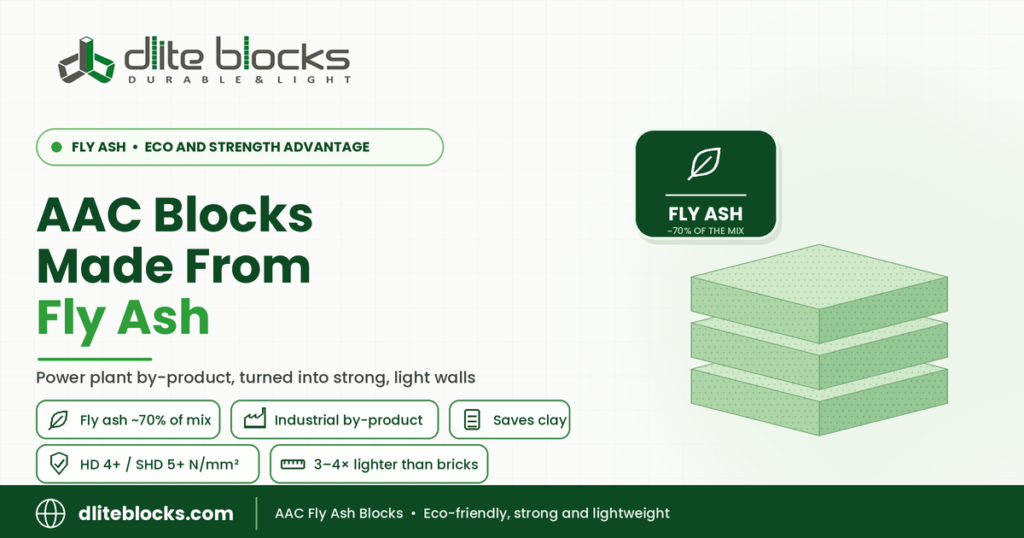
Fly ash is a fine by-product of coal-fired thermal power plants. Instead of letting it pile up as waste, Dlite Blocks turns it into strong, lightweight building material. Here’s why fly ash is at the heart of every Dlite AAC block.
Fly ash lets us make blocks that are lighter than clay bricks, well insulated and strong enough for modern construction, while using an industrial by-product and avoiding clay mining.
What Goes Into a Dlite Block?
Dlite AAC Fly Ash Blocks are made from fly ash, lime, cement and aluminium powder. Fly ash accounts for about 70% of the mixture, according to Dlite’s Indore page. The aluminium powder reacts to create millions of tiny air pores, so nearly 80% of the block’s volume is air. The blocks are then cured in an autoclave.
The Eco Advantage
Waste into value. Using fly ash helps reduce an industrial by-product that would otherwise need disposal.
Saving non-renewable resources. Conventional red bricks rely on clay. Dlite AAC blocks help conserve it.
Less water on site. Dlite notes that its blocks have very low curing requirements at the construction stage, which saves water.
Efficient transport. Because the blocks are 3–4 times lighter than red bricks, more fit on each vehicle, making logistics cheaper and more efficient.
Energy-efficient buildings. Superior insulation reduces heating and cooling demand over the building’s life.
The Strength and Performance Advantage
Fly ash doesn’t mean compromise. Dlite’s specifications include:
- Compressive strength: HD grade 4+ N/mm², SHD grade 5+ N/mm²
- Density: HD 551–650 kg/m³, SHD 651–750 kg/m³
- Thermal conductivity: below 0.24 W/m·K
- Fire resistance: 4–6 hours depending on wall thickness
- Sound reduction: 45 dB for a 200 mm wall
- Size tolerance: ±5 mm in length, ±3 mm in width and height
The blocks are also termite-resistant and unaffected by harsh weather, making them durable across seasons.
Where Fly Ash AAC Blocks Work Best
- Homes and apartments: thermal comfort and noise reduction
- Hospitals, schools and colleges: quiet, comfortable, safe spaces
- Commercial and office buildings: lighter structure and faster construction
- Warehouses and industrial units: fire, moisture and termite resistance
- Hotels and institutions: long-term energy savings
Experience Behind the Product
Dlite’s senior director, Mr. Vijay Kumar Jain, retired as GM (Production) at Hyderabad Industries, one of the pioneers of AAC fly ash blocks in India.
Fly Ash and Smarter Building
Pair our blocks with Dlite’s jointing mortar for thin joints, a clean finish and reduced mortar use. Blocks can also be cut, drilled, grooved and chased easily for electrical and plumbing work.
Conclusion
Fly ash is why Dlite AAC blocks are both greener and smarter. They are lightweight, insulating, fire-resistant and strong, and they put an industrial by-product to productive use. To see them in action, visit our Projects page or get in touch.
FAQs
1. What is fly ash?
A fine residue collected from thermal power plants.
2. How much fly ash is in Dlite blocks?
About 70% of the mix, with cement, lime and aeration agent making up the rest.
3. Are fly ash blocks strong?
Yes. Dlite’s HD blocks offer 4+ N/mm² and SHD blocks 5+ N/mm² compressive strength.
4. Are AAC fly ash blocks eco-friendly?
Yes. They use industrial waste, save clay and need little water for curing.
5. Are the blocks fire-resistant?
Yes. Dlite lists 4–6 hours of fire resistance depending on wall thickness.