
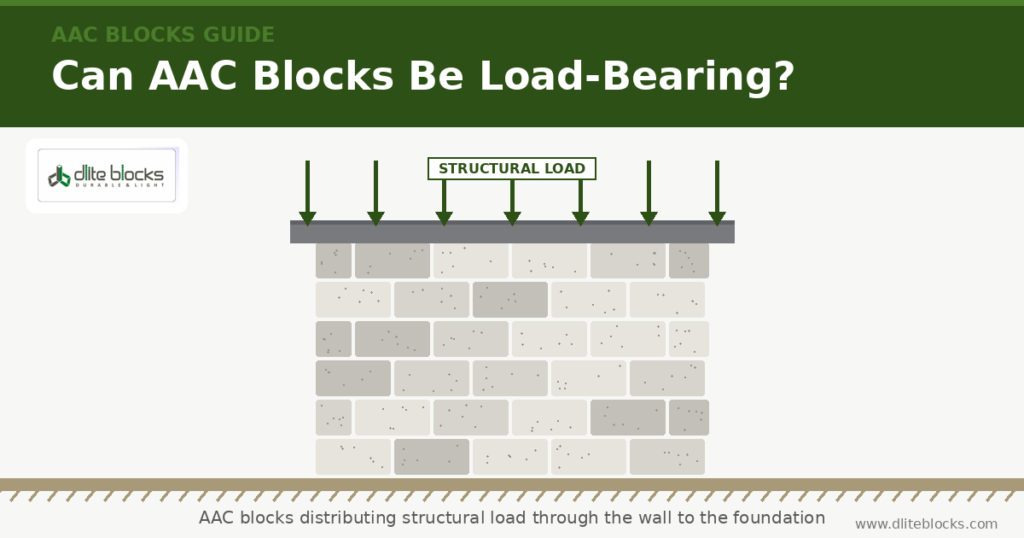
If you’re planning a residential or commercial project in India, you’ve likely come across AAC blocks as a modern alternative to red clay bricks. But one question keeps coming up among engineers, contractors, and homeowners alike: can AAC blocks be load-bearing?
The short answer is yes – AAC blocks can absolutely be used as load-bearing material, but with important conditions around block density, wall height, and structural design. Autoclaved Aerated Concrete, commonly known as autoclaved aerated concrete blocks or by the popular brand name siporex blocks, has been used in load-bearing construction across Europe for over 90 years, and Indian builders are now adopting the same principles for low-rise and mid-rise structures.
In this guide, we’ll break down exactly when an AAC block can carry structural load, what IS code guidelines say, how load-bearing AAC differs from standard infill-wall usage, and what to look for when choosing an AAC block supplier in India.
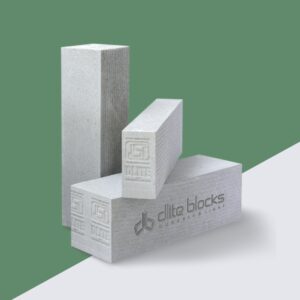
Understanding Load-Bearing vs. Non-Load-Bearing Use
Every AAC block manufactured under IS 2185 Part 3 has a rated compressive strength, typically ranging from 3 N/mm² to 5 N/mm² depending on the density grade. This strength determines whether the block is suitable only for partition walls (non-load-bearing) or whether it can support the weight of slabs and upper floors (load-bearing).
For load-bearing applications, structural engineers generally recommend:
- Higher-density blocks (typically 650 kg/m³ and above) for better compressive strength
- Building height restrictions – load-bearing AAC construction is most commonly used and code-approved for G+2 or G+3 structures in India
- Proper reinforcement at lintel level, plinth level, and corners using RCC bands
- Correct mortar jointing using thin-bed jointing mortar rather than conventional cement mortar, which preserves the block’s insulation and strength properties
This is different from how most urban high-rises use AAC blocks – as infill walls within an RCC frame structure, where the blocks themselves don’t bear structural load but still contribute significantly to thermal insulation, fire resistance, and speed of construction.
Market Analysis: Why Load-Bearing AAC Is Gaining Ground in India
Demand for autoclaved aerated concrete blocks in India has grown steadily as builders look for faster, lighter, and more sustainable alternatives to conventional brick masonry. A few market trends are worth noting:
- Affordable housing push: Government-backed affordable housing schemes favor low-rise (G+2/G+3) construction, which is precisely where load-bearing AAC blocks perform best – reducing both material cost and construction time compared to RCC frame structures.
- Rising steel and cement costs: As RCC framing costs climb, load-bearing AAC masonry offers a genuine cost advantage for smaller structures, since it reduces the volume of steel and concrete required.
- Growing number of manufacturers: The number of AAC block manufacturers in India has expanded rapidly over the past decade, particularly across Maharashtra, Madhya Pradesh, and Gujarat, improving both availability and AAC block price competitiveness compared to a decade ago.
- Comparison with fly ash bricks: Many buyers compare AAC blocks against traditional red bricks and fly ash brick price points. While fly ash bricks are often cheaper per unit, AAC blocks typically work out more economical on a per-square-foot built-up basis due to larger block sizes, less mortar consumption, and reduced plastering thickness – a key reason architects increasingly specify AAC for both load-bearing and infill applications.
This shift means that when evaluating an AAC block manufacturing company, buyers today are not just comparing price per block – they’re evaluating structural suitability, density consistency, and technical support for load-bearing designs.
What to Check Before Using AAC Blocks for Load-Bearing Walls
Before finalizing a project with load-bearing AAC masonry, verify the following with your chosen AAC block factory or supplier:
- Compressive strength test certificates conforming to IS 2185 Part 3
- Density grade documentation – confirm the block density matches your structural engineer’s specification
- Structural design approval from a licensed engineer familiar with load-bearing masonry codes
- Consistent block dimensions to ensure uniform load distribution across courses
- Reinforcement detailing at openings, corners, and bond beams
Working with an experienced AAC blocks company that understands both manufacturing and site-application requirements makes a significant difference in project outcomes, especially for first-time load-bearing AAC projects.
Conclusion
AAC blocks are structurally capable of load-bearing applications, particularly for low-rise residential and commercial buildings up to G+2 or G+3, provided the correct density grade, reinforcement, and jointing practices are followed. As one of the established AAC block manufacturers, Dlite Blocks produces IS 2185 Part 3 compliant AAC blocks suited for both load-bearing and infill wall applications across Maharashtra and pan-India markets.
Frequently Asked Questions
Can AAC blocks be used for load-bearing walls?
Yes. AAC blocks with adequate compressive strength and density can be used for load-bearing walls in structures up to G+2 or G+3, provided proper reinforcement and design guidelines are followed.
What density of AAC block is needed for load-bearing construction?
Higher-density AAC blocks, generally 650 kg/m³ or above, are recommended for load-bearing walls to ensure sufficient compressive strength.
How many floors can be built using load-bearing AAC blocks?
Load-bearing AAC construction is typically suitable for buildings up to G+2 or G+3 floors, depending on structural design and local building codes.
Is load-bearing AAC construction cheaper than RCC framing?
For low-rise structures, load-bearing AAC masonry can reduce steel and concrete consumption, often making it more cost-effective than a full RCC frame for the same built-up area.
Do load-bearing AAC blocks need special mortar?
Yes. Thin-bed jointing mortar is recommended over conventional cement mortar, as it maintains structural integrity while preserving the block’s thermal and acoustic properties.