
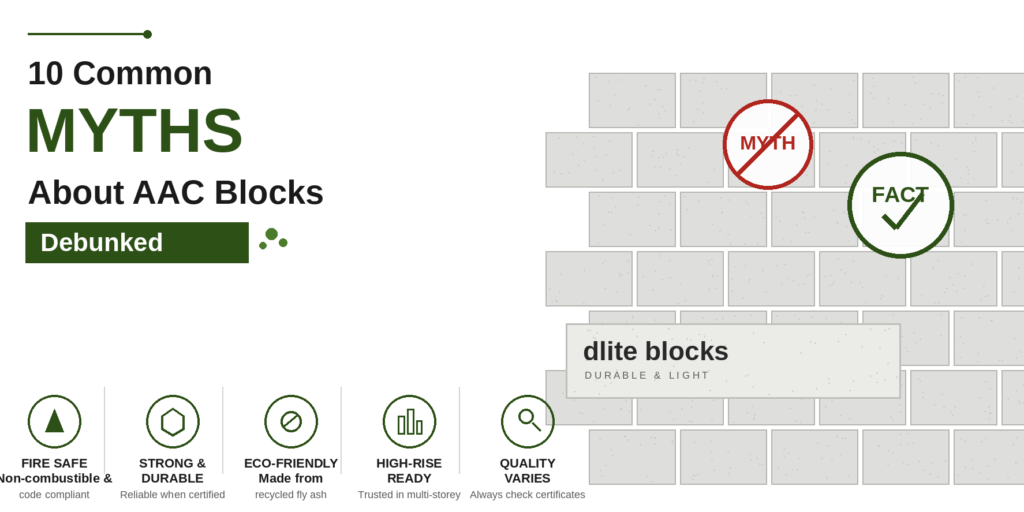
Despite growing adoption across India, AAC blocks are still surrounded by outdated assumptions left over from early, poorly-made batches or simple word-of-mouth confusion with other materials. If you’re a builder, contractor, architect, or homeowner comparing AAC blocks against fly ash bricks or red bricks, it’s worth separating the myths from what the material actually does. Here are the 10 most common misconceptions, debunked with facts.
Myth 1: AAC Blocks Are Too Fragile for Real Construction
Fact: This myth usually comes from handling low-quality, improperly autoclaved blocks. Blocks manufactured to IS 2185 Part 3 standards by a reputable AAC block manufacturing company go through precise autoclaving that gives them stable compressive strength suitable for both load-bearing and partition walls. The fragility perception fades quickly once builders switch to a properly certified AAC block supplier.
Myth 2: AAC Blocks and Siporex Blocks Are Different Materials
Fact: They’re not. Siporex blocks are simply a branded name for AAC (Autoclaved Aerated Concrete) blocks, made from the same core mix of fly ash, cement, lime, gypsum, and an aeration agent. Buyers sometimes assume Siporex is a premium alternative to AAC blocks, but it’s the same category of product — the differentiator is always the quality of the specific AAC block factory producing it, not the name on the packaging.
Myth 3: AAC Blocks Absorb Too Much Water
Fact: AAC blocks do have higher initial water absorption than dense red bricks because of their cellular structure — but this is exactly why proper plastering and correctly applied AAC block jointing mortar matter. Once finished correctly, AAC block walls perform reliably even through Maharashtra’s monsoon season. The issue isn’t the material; it’s skipping the recommended finishing steps.
Myth 4: AAC Blocks Are Always More Expensive Than Fly Ash Bricks
Fact: Comparing AAC blocks price to fly ash brick price per piece is misleading, since one AAC block typically replaces several standard bricks. Once mortar consumption, plaster thickness, and labor time are factored in, AAC blocks often work out more cost-effective per square foot of finished wall — a comparison worth asking any AAC block supplier to walk you through.
Myth 5: AAC Blocks Aren’t Fire Safe
Fact: The opposite is true. AAC blocks are non-combustible and offer strong fire resistance because of their inorganic composition and cellular air-pocket structure, which slows heat transfer. This is one of the reasons AAC blocks are increasingly specified for schools, hospitals, and commercial buildings where fire safety codes are strict.
Myth 6: All AAC Block Manufacturers Produce the Same Quality
Fact: Manufacturing quality varies significantly between AAC block manufacturers in India. Autoclaving time, pressure, raw material ratios, and quality testing procedures all differ by plant. Buyers comparing AAC block manufacturers in Maharashtra should ask for density, compressive strength, and thermal conductivity test data rather than assuming all AAC blocks manufacturers meet the same standard.
Myth 7: Any Cement Mortar Works Fine With AAC Blocks
Fact: Ordinary cement-sand mortar creates thick joints (12-15mm) that increase thermal bridging and material use. A dedicated AAC block jointing mortar is formulated for the dense, smooth surface of autoclaved blocks, allowing thin 2-3mm joints that preserve the wall’s insulation performance and reduce cracking. Sourcing jointing mortar from unrelated jointing mortar suppliers instead of a matched product is a common cause of on-site issues.
Myth 8: AAC Blocks Are Only Suitable for Low-Rise Buildings
Fact: AAC blocks are used globally in mid-rise and high-rise projects as infill and partition walls, valued precisely because their light weight reduces the structural load on the building frame compared to red brick or dense concrete block. Leading AAC block manufacturers in India regularly supply high-rise residential and commercial projects.
Myth 9: AAC Blocks Aren’t Eco-Friendly Because They Use Cement
Fact: AAC blocks use fly ash — an industrial byproduct that would otherwise go to landfill — as their primary raw material, reducing both waste and the need for clay excavation required by red bricks. While cement is part of the mix, the overall environmental footprint of AAC blocks is considerably lower than traditional fired-clay bricks.
Myth 10: Any Supplier With a Low Quote Is a Good Deal
Fact: Price alone doesn’t indicate quality. A low quote from an unverified AAC block supplier can mean under-cured blocks, inconsistent dimensions, or inflated transport costs hidden elsewhere. It’s worth evaluating AAC blocks manufacturers on test certification, factory transparency, and whether they also supply a matched AAC block jointing mortar — not on price alone.
What This Means for Your Next Project
Most myths about AAC blocks trace back to either outdated information or experience with a poor-quality AAC block supplier — not a flaw in the material itself. When sourced from a certified AAC block manufacturing company and paired with the right jointing mortar, AAC blocks consistently outperform traditional alternatives on speed, insulation, and durability.
Dlite Blocks, based in Akola, Maharashtra, manufactures AAC blocks and matched jointing mortar to IS 2185 Part 3 standards, supplying builders, architects, and homeowners across Maharashtra and pan-India. Explore specifications on the AAC blocks and jointing mortar product pages or get in touch with questions before your next project.
For more buying guides and construction insights, visit the Dlite Blocks blog.
FAQ
-
Are AAC blocks weaker than red bricks?
No. Properly manufactured AAC blocks meeting IS 2185 Part 3 standards offer reliable compressive strength for both load-bearing and partition walls.
-
Is Siporex a different product from AAC blocks?
No, Siporex is simply a branded name for AAC (Autoclaved Aerated Concrete) blocks, made from the same core materials and process.
-
Do AAC blocks need special mortar?
Yes, AAC block jointing mortar is specifically formulated for AAC’s dense surface, creating thin joints that preserve strength and insulation better than ordinary cement mortar.
-
Are AAC blocks fire resistant?
Yes, AAC blocks are non-combustible and offer strong fire resistance due to their inorganic, air-pocketed structure.
-
Can AAC blocks be used in high-rise buildings?
Yes, their light weight makes AAC blocks a common choice for infill and partition walls in mid-rise and high-rise construction.