
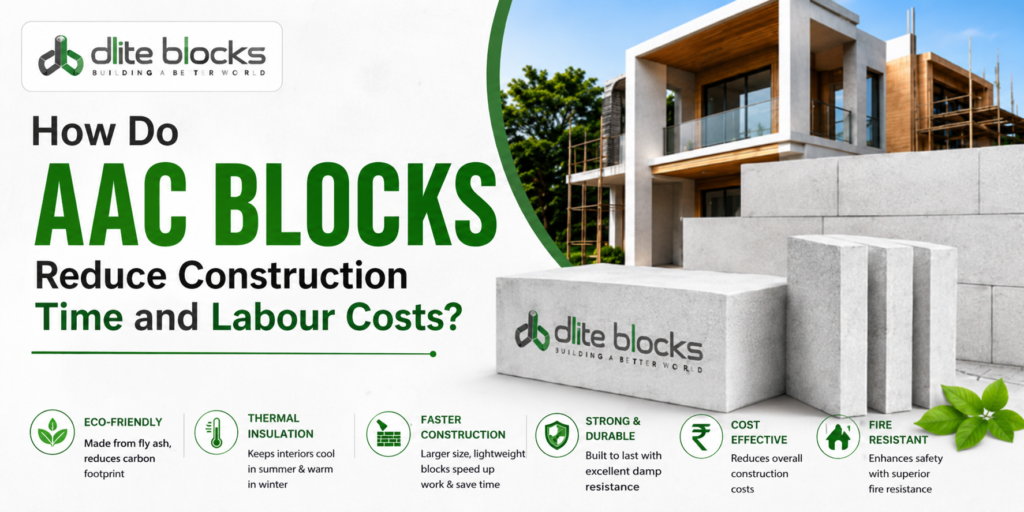
AAC blocks cut construction time by roughly 25–30% and reduce walling labour costs by lowering the number of units laid, the volume of mortar mixed, the plaster applied, and the dead load the foundation must carry. A 600×200×200 mm AAC block replaces about nine standard red bricks, so a mason lays fewer units, uses thin-bed jointing mortar instead of thick site-mixed mortar, and finishes the wall with a skim coat instead of 12–15 mm of plaster.
Labour is now the fastest-rising line item on most Indian sites. Material prices get scrutinised; idle man-days do not. Below is where AAC blocks actually claw that time back — and where they do not.
How much lighter are AAC blocks than red bricks?
AAC blocks have a dry density of 550–650 kg/m³, against 1,600–1,920 kg/m³ for red clay bricks. In practice a completed AAC wall weighs roughly one-third of an equivalent brick wall.
That weight difference shows up as labour savings in two places:
- Less fatigue per unit laid. Workers move and place blocks with less physical effort, sustaining output through the shift instead of tapering off.
- Cheaper vertical transport. Hoisting a third of the mass to upper floors means fewer trips, less lifting equipment time, and fewer helpers dedicated to material movement.
Why does block size speed up wall construction?
A standard brick is 225×100×75 mm. A standard AAC block is up to 600×200×200 mm — around nine bricks’ worth of wall in a single lift.
Fewer units means fewer laying actions, fewer joints, and fewer alignment corrections. The same daily wall area is achieved with a smaller crew, which shrinks the daily wage bill directly rather than theoretically.
How does thin-bed jointing mortar reduce labour cost?
Conventional brickwork needs 10–12 mm of site-mixed mortar, which needs a skilled mason to keep the course level. AAC blocks are cut to tight dimensional tolerance, so they take a 2–3 mm thin-bed jointing mortar instead.
The consequences:
- Less mortar consumed per square metre of wall.
- Less mixing labour on site — the premix arrives ready to gauge with water.
- Lower skill dependency. Applying thin-bed adhesive to a flat, true block face is a trainable task. Highly-paid specialist masonry crews are needed for less of the work.
Jointing mortar is not optional. AAC laid in ordinary cement mortar loses most of its speed advantage and gains joint-line cracking. Match the block to a purpose-made adhesive such as Dlite AAC Block Jointing Mortar.
Do AAC block walls need less plaster?
Yes. Because the blocks are dimensionally accurate, the wall face comes out true. Where a rough brick wall needs a thick levelling coat, an AAC wall typically needs only a thin plaster or skim coat.
That removes days from the finishing programme, reduces cement and sand consumption, and frees a plastering crew earlier for the next block of work.
How does lower dead load save foundation labour?
Lighter walls mean a lighter building. A lighter building means:
- Less steel reinforcement to cut, bend, and tie
- Less concrete to pour in footings and columns
- Fewer man-hours in the most labour-intensive phase of the project
On a multi-storey RCC frame, the dead-load reduction from AAC infill walls is one of the few walling decisions that shows up in the structural drawings, not just the finishing bill.
Where AAC does not save you time
Two honest caveats, because sites find them out anyway:
- Blocks must be handled dry and stored covered. Wet AAC absorbs water and slows the mortar set.
- Chasing for conduits and plumbing needs the right tools. A wall chaser cuts clean; a hammer and chisel damages the block face and creates rework.
The bottom line
Every hour saved on site is margin retained. AAC blocks compress the walling programme at five separate points — handling, laying, jointing, plastering, and foundation work — which is why the time saving compounds instead of showing up as a single line item.
Planning a project? Talk to the Dlite Blocks team about the right block grade and jointing mortar for your build.
FAQ
How much faster is construction with AAC blocks?
AAC block walling is typically 25–30% faster than red brick walling. The gain comes from laying fewer, larger units, using thin-bed jointing mortar instead of thick site-mixed mortar, and needing only a skim coat of plaster instead of a thick levelling coat.
Do AAC blocks reduce labour cost, or just material cost?
Both, but the labour saving is larger. Fewer units laid, less mortar mixed, thinner plaster, and less steel and concrete in the foundation all cut man-hours. Material cost per block is higher than a brick; total installed wall cost is usually lower.
Do AAC blocks need skilled masons?
Less than brickwork does. Because the blocks are dimensionally accurate and laid in a 2–3 mm thin-bed adhesive, alignment is largely built into the block. General labour can carry much of the work under supervision, reducing dependence on high-wage masonry crews.
Can I use ordinary cement mortar with AAC blocks?
It is not recommended. Ordinary mortar requires a 10–12 mm bed, which cancels most of the speed advantage and increases the risk of joint cracking. Purpose-made AAC jointing mortar is applied at 2–3 mm and sets faster.
Do AAC block walls still need plastering?
Usually only a thin coat. The smooth, true face of an AAC wall does not need the thick levelling plaster a rough brick wall requires — a skim coat or thin plaster is generally sufficient, which shortens the finishing stage by days.
How many bricks does one AAC block replace?
One 600×200×200 mm AAC block occupies roughly the same wall volume as nine standard 225×100×75 mm bricks. That means fewer laying actions, fewer joints, and less mortar per square metre of wall.