
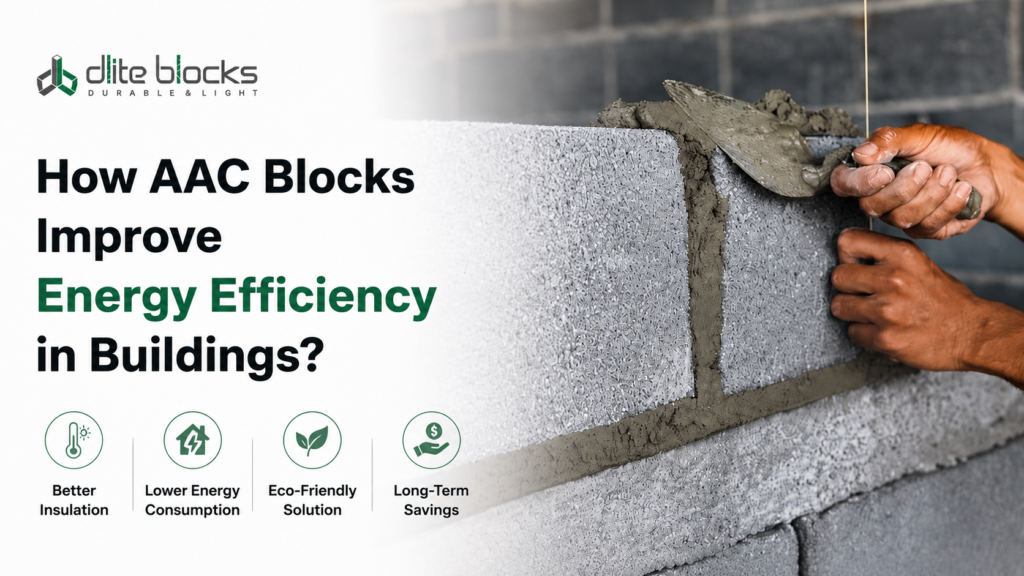
AAC blocks are becoming the default walling material for modern construction in India because they are up to 50–70% lighter than red clay bricks, insulate far better against heat, absorb less water, and build roughly 30% faster. For most residential, commercial, and institutional projects in 2026, they cut both build time and lifetime running costs — which is why builders across the country are switching away from traditional bricks.
Here is a clear, data-backed look at what AAC blocks are, how they compare to red bricks, where the India market is heading, and where a manufacturer like Dlite Blocks fits in.
What Are AAC Blocks, and How Are They Made?
AAC stands for Autoclaved Aerated Concrete. AAC blocks are precast, lightweight blocks made from fly ash, cement, lime, gypsum, and water, mixed with a small amount of aluminium as an aeration agent, then steam-cured under pressure inside an autoclave. During curing, the mix expands and traps millions of tiny air pockets — and those pockets give the finished block its low weight and strong thermal performance.
Because the main raw material is fly ash — an industrial waste product from thermal power plants — AAC blocks reuse waste instead of stripping fertile topsoil the way clay-brick kilns do. Indian brick-making is estimated to consume the top 300 mm of fertile agricultural soil in affected areas over decades, an environmental cost documented by researchers at the MIT Energy Initiative. That single fact is a big reason government and green-building bodies now favour fly-ash-based blocks.
Key technical specifications of AAC blocks:
- Dry density: 550–650 kg/m³ (vs 1,600–1,920 kg/m³ for red bricks)
- Compressive strength: 3–4.5 N/mm²
- Thermal conductivity: 0.16–0.42 W/mK (vs 0.6–1.0 W/mK for red bricks)
- Water absorption: ≤ 10% (vs 15–20% for red bricks)
- Fire resistance: up to 4 hours for a 100 mm wall
These specifications follow the Indian standards published by the Bureau of Indian Standards (BIS).
AAC Blocks vs Red Bricks: The Core Differences
A single AAC block can replace several red bricks. That one fact drives most of the advantages — fewer joints, less mortar, lower dead load on the structure, and lighter foundations.
| Parameter | Red Clay Bricks | AAC Blocks |
|---|---|---|
| Standard size | ~225 × 100 × 75 mm | Up to 600 × 200 × 200 mm |
| Dry density | 1,600–1,920 kg/m³ | 550–650 kg/m³ |
| Thermal conductivity | 0.6–1.0 W/mK | 0.16–0.42 W/mK |
| Water absorption | 15–20% | ≤ 10% |
| Construction speed | Slower (small units) | ~30% faster |
| Raw material | Clay + high kiln energy | Fly ash, lower energy |
Where AAC clearly leads is thermal insulation and water resistance. Lower thermal conductivity means interiors stay cooler through the Indian summer, directly cutting air-conditioning load. For raw strength, good-quality units of both materials are adequate for most residential walls — in multi-storey buildings, AAC is typically used as non-load-bearing infill inside an RCC frame. The full engineering trade-offs are documented by references like The Constructor.
The India Market in 2026: Why the Shift Is Accelerating
The numbers explain the switch. India’s AAC blocks market reached USD 4.0 billion in 2025 and is projected to hit USD 9.1 billion by 2034, growing at a 9.5% CAGR, according to the IMARC Group. Meanwhile, India still produces roughly 250 billion red clay bricks every year — one of the largest such industries in the world — which shows just how much of the market is still open to conversion.
Three forces are driving the change: government housing schemes like the Pradhan Mantri Awas Yojana (PMAY), which lists AAC blocks among preferred fast-build materials; rising demand for green building certifications from the Indian Green Building Council; and a GST rate of just 5% on AAC blocks. Add climbing labour and energy costs, and clay-brick economics keep weakening while AAC’s faster builds and lower running costs look stronger every year.
Saving Time and Money on Site
Cost is where AAC blocks win over the life of a build, not just at the checkout. Because the blocks are much larger than red bricks, masons lay walls faster. You need less cement mortar to join them, and their smooth, dimensionally accurate faces need very little plaster.
The bigger saving is structural. Lighter walls mean lower dead load, which can reduce the steel and concrete needed in foundations and columns. And because of their insulation, AAC walls cut the electricity spent on cooling for the entire life of the building. The right comparison is the total cost of ownership — fewer units, less mortar and plaster, lighter foundations, and years of lower power bills — not the price of a single block.
Where Dlite Blocks Fits In
Dlite Blocks is an AAC fly-ash block manufacturer based in Akola, Maharashtra, supplying dealers and builders across Maharashtra and Madhya Pradesh, with a presence in Indore. Its leadership team brings nearly five decades of combined experience in the AAC industry.
At its AAC block factory in Akola, Dlite produces precision-cut AAC fly ash blocks alongside its own AAC block jointing mortar — a thin-bed adhesive that speeds up masonry and improves wall integrity. Its blocks have been used across residential, commercial, healthcare, and institutional projects. For any builder weighing AAC blocks vs red bricks, sourcing from a quality-controlled AAC blocks company is what turns AAC’s theoretical advantages into real on-site performance, because density consistency and dimensional accuracy matter as much as the material itself.
Conclusion: Build Smarter
For most new construction in India in 2026 — apartments, offices, hospitals, schools, and modern homes — AAC blocks are the smarter choice. They cut structural weight, lower cooling and heating bills through superior insulation, resist fire and moisture better, and build faster. Red bricks still suit tight-budget, small-scale, load-bearing work where upfront cost is the only priority. But as energy costs rise and green-building norms tighten, the long-term case keeps tilting toward AAC.
Planning your next project? Talk to the Dlite Blocks team about the right AAC block grade and jointing mortar for your build.
Frequently Asked Questions (FAQ)
What are the main benefits of AAC blocks over red clay bricks?
AAC blocks are 50–70% lighter than red clay bricks, insulate far better (thermal conductivity of 0.16–0.42 W/mK vs 0.6–1.0 W/mK), absorb less water (≤10% vs 15–20%), and build around 30% faster. Together these lower construction time, labour cost, and long-term electricity bills, which is why AAC blocks are now preferred for modern homes, offices, and hospitals across India.
Are AAC blocks more expensive than red bricks?
The per-block price of AAC can be slightly higher, but the total wall cost is usually lower. You need fewer units, less cement mortar and plaster, lighter foundations, and less steel — and you save on air-conditioning electricity for years. When you compare total cost of ownership rather than unit price, AAC blocks generally work out cheaper over a building’s life.
How do I choose a reliable AAC blocks company in India?
Look for an AAC blocks company that manufactures to BIS standards, maintains consistent block density and dimensional accuracy, and supplies matching AAC block jointing mortar. Consistent quality is what delivers AAC’s promised thermal and structural performance on site, so buy from a manufacturer with proven project references rather than the cheapest available supplier.
Can a small contractor order directly from an AAC block factory?
Yes. As the retail market grows, a modern AAC block factory increasingly accepts smaller orders from individual home builders and local contractors, not just large institutional buyers. This makes AAC blocks practical even for single-home construction, letting small projects benefit from the same lightweight, energy-efficient walling used in large developments.
Are AAC blocks safe in earthquake-prone and heavy-rainfall areas?
AAC blocks reduce a building’s overall dead load because they are lightweight, which lowers the seismic forces acting on the structure during an earthquake. Their closed pore structure keeps water absorption at or below 10%, so they resist dampness better than red bricks — though external walls in high-rainfall zones should still be plastered or clad to prevent long-term moisture ingress.